
Wednesday, June 4, 2014
Ill-Gotten Games: Pauper Mono Black #2
Zoners! Your weekly dose of Ill-Gotten games is here! Today we are playing more Pauper with the same deck from last week. Why so much Pauper? Well, it is my favorite deck in one of my favorite formats. Also: don't ask so many questions. Next week we will have something completely different. Enjoy the vids!

Tuesday, June 3, 2014
Conspiracy: The Legends
Heya Zoners!
There's a new non-Standard set ready to release this Friday. While it may be more for the Cubers, there's a few new Legendary Creatures on the landscape, which means Wizards didn't totally forget us, which means we have tech to talk about.
THE OLD
 We'll begin by recapping unheard opinions on nonsense that already exists.
I have to say, I'm glad they went with the invasion artwork. This card is kind of a running joke in my metagame, because most of the players who play this have the promo with the world's most horrible foiling.
Perhaps there's now a good way to find a cheap copy of her so we don't have to avert our eyes.
 While Phage has seen significant printing in both borders, this is something I'm not crazy about, but in more of an understanding mood.
Phage seems fun in a cube format, and I enjoy the artwork and things that go along with her.
This artwork feels a little like a "digitally remastered" version, for some reason. Maybe it is. Everything looks smoother and sleeker. Phage in Blu-Ray. In Stores June 6th.
 My love for HH is well-documented here, and it remains one of my favorite decks.
Still, I don't see the cube value of this card. After spending serious time drafting and picking out cards, HH is put into this Cube pool to make the game go faster?
In my experience with Cube and FNM Draft formats, I understand how it relates to the latter. In cube though, there are a lot of players with 20 life. In Commander, HH's first ability trigger is a big chunk, but it keeps people in the game. The second hit is brutal.
I'm not saying it's wrong to put this card in cube, or that it's unwelcome- I just don't get why you would versus other choices. Especially when the set's mechanics seem to be giving off a more political vibe. From my experience playing HH, he is the equivalent of the Honey Badger (The Meme, not Tyrann Mathieu). He just doesn't give a shit. Everyone takes pain equally, and through all the hurting, you've got to figure out how to stay alive.
 On a Stack episode some time ago, I tore this card apart. I like Terese Nielsen, but I don't like this art. It looks like the kind of artwork people have on rugs that they hang on their walls. Not that there is anything wrong with this, if it looks good. Beauty is never in the eyes of this beholder. I have a completely different perspective on this altogether.
However, my assessment of what Basandra does hasn't changed. She's a legend that came out before we started blogging here, so I'll give you a couple pennies worth of knowledge you probably already know.
This card is poorly designed. I continue to die a little inside every time I have to attempt to understand why Wizards prints a card in these colors that with the most counter-intuitive rules text of all time. Were this Time Spiral, I might get it. That was the point in time which Wizards could wear the proverbial "Do-Whatever-I-Want-And-Get-Away-With-It" Badge, and that time has long expired. Were they to have announced another Spiral-esque block in the Fall, I might've even given them a pass too.
But I really can't stand this card. It's just so bad, it's hard for me to look at. I encourage you all to do the same. Just look away, kids.
 Last of the old business, we have Edric.
Case you don't know, this deck is good. This card is good. The deck is aggressive. It's enough to confuse most players, even good ones, into thinking that they shouldn't attack someone with an army of Elves or 1-drops on the board by Turn 5.
What you have to understand about Edric is that when you play against this deck, everything you know is wrong. Welcome to Crazy World, the place where you don't want to draw cards, and there's someone attacking you with a bunch of little guys for lethal before turn 10 with counterspell backup.
There's a reason it's banned in 1v1. Edric's pure value there, and that's apparently too unfair for most people.
THE NEW
 Let's start with Brago, the King of Blink.
While he may be one color short of Roon of the Hidden Realm, the dedication to blink colors and no-nonsense artwork courtesy of Karla Ortiz means those seeking ETB value not have to have a goofy kid's show character at the helm.
Not that there's anything wrong with this- I play silly decks all the time. Still, sometimes being a better player means respecting yourself, so that others respect you. If you're a believer in stuff like this, then the King Eternal is the Blink Deck Commander for you.
 Next up is Selvala, sporting some goofy conquistador garb and and equally strange mechanic. A little too "Pirates of the Caribbean" and Group Hug for me.
What interests me about this card is the way the rules work here. What happens if Omen Machine is in play? What about activating this on an opponent's turn with Spirit of the Labyrinth in play? Where does the card go?
Though I'm not into this card, being a 2/4 for three is pretty appealing. We're seeing this a lot more, and it's clearly a home run in Standard right now. I guess if you love Courser of Kruphix, this is the Commander for you.
If this card was a little more selfish, and by selfish, I mean, wasn't part of the silly Parley mechanic where everyone draws a card, I could really get behind it. The life gain and mana in multiplayer matchups seems like a huge boost. I wouldn't recommend bringing this strangely gender-ambiguous character to the table in 1v1 though.
 It's as clear to me as it is to everyone else that Marchesa is the gem of the Legends in this set.
Dethrone as a mechanic is slightly more political than I'd like it to be, but is totally manageable with access to Black. The key will be to get liberal with Ad Nauseam and Necropotence.
What's silly about this card being printed is that she already has a great dance partner in Black Mike (AKA Mikaeus, the Unhallowed), which gives this deck great value and design space.
My only real criticism of the card is that I think it does "too much." Other than that, I really love it. Matt Stewart's vision of Marchesa is stunning in every sense- colors, form, details. I'm not sure how any of her abilities make her a Wizard (The ability and artwork SCREAM Human Advisor), but this is going to be a hit, and going to be at tables.
 With Grenzo, we have another hit. If Wizards places their pegs right, they might actually be sinking my Battleship today.
I'm surprised the bottom-of-library-to-graveyard mechanic hasn't taken off. In Innistrad, we got the ever flavorful Cellar Door, which was sweet, but something the world seems to have forgotten.
What I'm hoping for with Grenzo is that there will be more of these kinds of cards, and they will be good. Grenzo has a very interesting set of abilities that have been put together, and I'm excited to see what comes of it.
With an X cost in his identity, and a non 0/0 P/T, Grenzo's flexibility makes him aggressive like a Goblin while also giving him the potential to be big, like his Rakdos counterparts.
Combined with other seldomly used tricks like Reito Lantern, Grenzo really feels like a fun deck for the table. Definitely the one I'm most likely to play out of the set.
 Last but not least, we have the world's most Italian Magic Card of all-time. Muzzio!
I hope more people will be saying his name than Arcum's soon. Although he's definitely underpowered in comparison, the lone mono-colored legend is basically giving us a look that says "Break Me."
Now, I don't think it's supposed to, but this artwork makes me laugh. It's so clear that Muzzio's da Vinci inspired by the eccentricities and inventions in the background it hurts. I'm not sure what he's wearing though. Looks like he bought clothes off the Aladdin mannequin at Disney. I guess he really wants to show us a whole new world.
What are your thoughts on Conspiracy? What cards are you interested in? Let us know in the comments down below.
Pass.
-UL
There's a new non-Standard set ready to release this Friday. While it may be more for the Cubers, there's a few new Legendary Creatures on the landscape, which means Wizards didn't totally forget us, which means we have tech to talk about.
THE OLD
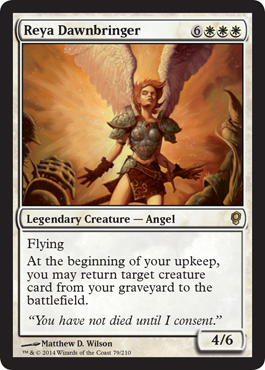
I have to say, I'm glad they went with the invasion artwork. This card is kind of a running joke in my metagame, because most of the players who play this have the promo with the world's most horrible foiling.
Perhaps there's now a good way to find a cheap copy of her so we don't have to avert our eyes.
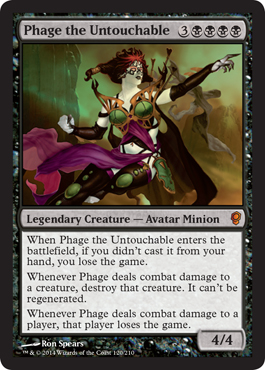
Phage seems fun in a cube format, and I enjoy the artwork and things that go along with her.
This artwork feels a little like a "digitally remastered" version, for some reason. Maybe it is. Everything looks smoother and sleeker. Phage in Blu-Ray. In Stores June 6th.
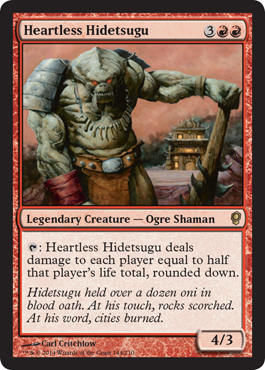
Still, I don't see the cube value of this card. After spending serious time drafting and picking out cards, HH is put into this Cube pool to make the game go faster?
In my experience with Cube and FNM Draft formats, I understand how it relates to the latter. In cube though, there are a lot of players with 20 life. In Commander, HH's first ability trigger is a big chunk, but it keeps people in the game. The second hit is brutal.
I'm not saying it's wrong to put this card in cube, or that it's unwelcome- I just don't get why you would versus other choices. Especially when the set's mechanics seem to be giving off a more political vibe. From my experience playing HH, he is the equivalent of the Honey Badger (The Meme, not Tyrann Mathieu). He just doesn't give a shit. Everyone takes pain equally, and through all the hurting, you've got to figure out how to stay alive.
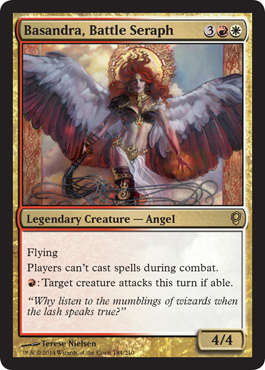
However, my assessment of what Basandra does hasn't changed. She's a legend that came out before we started blogging here, so I'll give you a couple pennies worth of knowledge you probably already know.
This card is poorly designed. I continue to die a little inside every time I have to attempt to understand why Wizards prints a card in these colors that with the most counter-intuitive rules text of all time. Were this Time Spiral, I might get it. That was the point in time which Wizards could wear the proverbial "Do-Whatever-I-Want-And-Get-Away-With-It" Badge, and that time has long expired. Were they to have announced another Spiral-esque block in the Fall, I might've even given them a pass too.
But I really can't stand this card. It's just so bad, it's hard for me to look at. I encourage you all to do the same. Just look away, kids.
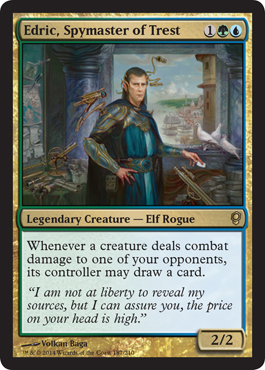
Case you don't know, this deck is good. This card is good. The deck is aggressive. It's enough to confuse most players, even good ones, into thinking that they shouldn't attack someone with an army of Elves or 1-drops on the board by Turn 5.
What you have to understand about Edric is that when you play against this deck, everything you know is wrong. Welcome to Crazy World, the place where you don't want to draw cards, and there's someone attacking you with a bunch of little guys for lethal before turn 10 with counterspell backup.
There's a reason it's banned in 1v1. Edric's pure value there, and that's apparently too unfair for most people.
THE NEW
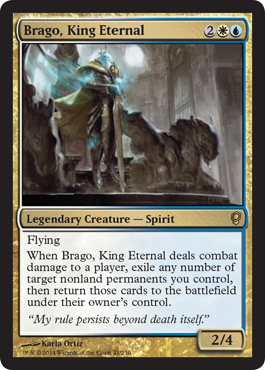
While he may be one color short of Roon of the Hidden Realm, the dedication to blink colors and no-nonsense artwork courtesy of Karla Ortiz means those seeking ETB value not have to have a goofy kid's show character at the helm.
Not that there's anything wrong with this- I play silly decks all the time. Still, sometimes being a better player means respecting yourself, so that others respect you. If you're a believer in stuff like this, then the King Eternal is the Blink Deck Commander for you.
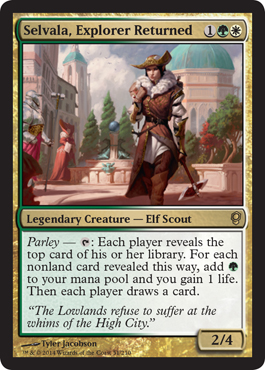
What interests me about this card is the way the rules work here. What happens if Omen Machine is in play? What about activating this on an opponent's turn with Spirit of the Labyrinth in play? Where does the card go?
Though I'm not into this card, being a 2/4 for three is pretty appealing. We're seeing this a lot more, and it's clearly a home run in Standard right now. I guess if you love Courser of Kruphix, this is the Commander for you.
If this card was a little more selfish, and by selfish, I mean, wasn't part of the silly Parley mechanic where everyone draws a card, I could really get behind it. The life gain and mana in multiplayer matchups seems like a huge boost. I wouldn't recommend bringing this strangely gender-ambiguous character to the table in 1v1 though.
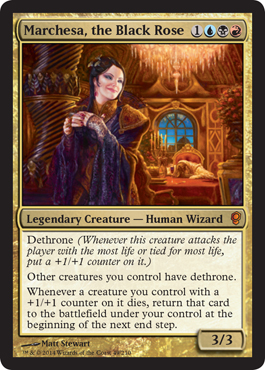
Dethrone as a mechanic is slightly more political than I'd like it to be, but is totally manageable with access to Black. The key will be to get liberal with Ad Nauseam and Necropotence.
What's silly about this card being printed is that she already has a great dance partner in Black Mike (AKA Mikaeus, the Unhallowed), which gives this deck great value and design space.
My only real criticism of the card is that I think it does "too much." Other than that, I really love it. Matt Stewart's vision of Marchesa is stunning in every sense- colors, form, details. I'm not sure how any of her abilities make her a Wizard (The ability and artwork SCREAM Human Advisor), but this is going to be a hit, and going to be at tables.
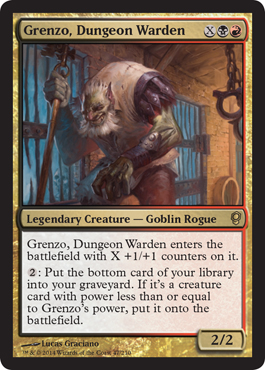
I'm surprised the bottom-of-library-to-graveyard mechanic hasn't taken off. In Innistrad, we got the ever flavorful Cellar Door, which was sweet, but something the world seems to have forgotten.
What I'm hoping for with Grenzo is that there will be more of these kinds of cards, and they will be good. Grenzo has a very interesting set of abilities that have been put together, and I'm excited to see what comes of it.
With an X cost in his identity, and a non 0/0 P/T, Grenzo's flexibility makes him aggressive like a Goblin while also giving him the potential to be big, like his Rakdos counterparts.
Combined with other seldomly used tricks like Reito Lantern, Grenzo really feels like a fun deck for the table. Definitely the one I'm most likely to play out of the set.
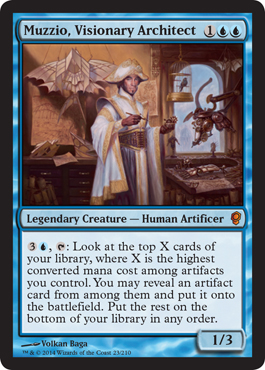
I hope more people will be saying his name than Arcum's soon. Although he's definitely underpowered in comparison, the lone mono-colored legend is basically giving us a look that says "Break Me."
Now, I don't think it's supposed to, but this artwork makes me laugh. It's so clear that Muzzio's da Vinci inspired by the eccentricities and inventions in the background it hurts. I'm not sure what he's wearing though. Looks like he bought clothes off the Aladdin mannequin at Disney. I guess he really wants to show us a whole new world.
What are your thoughts on Conspiracy? What cards are you interested in? Let us know in the comments down below.
Pass.
-UL
Saturday, May 31, 2014
In General: Advantage Theories Part 2
Hello and welcome back to In General. In this series we talk about a vast array of topics relating, sometimes only loosely, to the game of Magic. Last week we discussed Advantage and several key measurements you can use to decide who has the advantage in a given game or matchup. That article can be found: Here! Today we will conclude our discussion of advantage in MtG by discussing two of the more complex theories: Interaction advantage and Mana Sum Theory.
Interaction Advantage:
Interaction is a word that gets tossed around quite a bit in coverage. Simply put, interaction is the name for using your cards to negate, nullify, circumvent, or overcome your opponents cards. Duress-ing your opponent's hand? Interactive. Countering an opposing spell? Interactive. Blocking and incoming attacker? Interactive. Interaction is the capability of your cards to do something meaningful about the opponent's cards. The person with more cards that can FAVORABLY interact with their opponent has the interaction advantage. To illustrate, let's talk about two examples:
Have you ever played a match where you went to side boarding and thought...'I have nothing good to bring in'? Even worse, have you been in the situation where you have so many dead cards to take out that you just don't have enough good cards to replace them? This is a telltale sign that you are at an interaction disadvantage.
Second scenario: Generic Burn deck vs. Generic Combo deck (think Modern Twin vs Mono Red Burn). These archetypal match-ups tend to play out as pure race scenarios. Because neither player has any ability to interact with the other, they are forced to simply win faster in order to win at all.
A simply way to quantify interaction advantage is to take each card in your deck, multiply the number of copies of that card by the number of cards that it interacts favorably against in your opponent's deck. If you sum up these values for all cards in a player's deck you will have what I call the Interaction Index, or I^2 value. The theoretical maximum is 3600 and the minimum is, of course, 0. The higher the number the more interactive your deck is.
There are some problems with using interaction as an advantage metric though. As I pointed out above, you can build purely non-interactive decks in MtG. Some are very strong in fact. These decks have an I^2 of close to zero, but are still very good. E.g. ANT in Legacy. Secondly, interaction is a highly reactive strategy element. There are many formats where simply having a strong proactive game plan is superior to trying to disrupt your opponent's strategy. E.g. Triple Theros Draft or Cube. Lastly, consider the nature of interactive cards, i.e. removal, counterspells, and disruption. They each only work at specific times. Thoughtseize won't interact with a Creature that is already in play. Having the broadest possible answers, and a good mix of different kinds of answers, is necessary to having a strong interactive deck, but that isn't any guarantee of victory.
Mana Sum Theory:
So far, most of the advantage metrics I have discussed break down when you try to use them on 'unfair' decks. Combo decks tend to use resources in an unconventional way; combining cards to generate more than the sum of their parts. Most combo decks though, still utilize the core mechanic of the game: using mana to cast spells. Finally we have a theory that can successfully measure advantage even among decks that aren't trying to win in the same way.
The mana sum is a measurement of how much mana you SPEND throughout the game. Not just how many lands you get into play, but how much mana actually gets used to DO SOMETHING. The idea that drives this theory is that most cards are balanced using their mana cost; meaning that each unit of mana has some value in the context of the game. It is a measurement of the power to produce effects. With no mana, or nothing to spend your mana on, you cannot affect the game state. This conclusively explains both flood and screw, which are difficult corner cases for other theories to evaluate.
Mana sum theory also elegantly accesses the idea of mana efficiency. Using ALL your mana on every turn is a very easy way to get ahead in a game. Think of an aggro deck's 'god draw'. It is hard to beat a deck that curves out perfectly because they are constantly doing the most they can to affect the board on every turn.
To evaluate who has the advantage in mana sum you simply need to add up all the mana that you have spent in the game and compare it to your opponents. You will be surprised how often the player who spends the most, wins the most.
And now, one final note. Despite the fact that mana sum theory is our most robust, most developed advantage theory, it still has a few problems, but they are somewhat niche. Free spells and effects that don't require mana (like tap abilities) are definitely useful in the game, but do not add to your mana sum. This can mislead you into thinking that your deck isn't doing as much as it really is. Also, Dredge. The perennial boogie man of the Legacy format, and Magic in general, Dredge wins easily by spending little or sometimes no mana. The mechanics of this deck are so unconventional that we really don't have a good way to describe it.
There is not a grand unified theory of advantage in Magic, but there is an abundance of good indicators you can use to assess who is ahead. I hope that this article has helped you learn about a few new ones so that you may grow in your ability to analyze the game. As always, leave any comments or questions below. I'll see you again next Sunday when we begin coverage of Conspiracy!
-GG
Interaction Advantage:
Interaction is a word that gets tossed around quite a bit in coverage. Simply put, interaction is the name for using your cards to negate, nullify, circumvent, or overcome your opponents cards. Duress-ing your opponent's hand? Interactive. Countering an opposing spell? Interactive. Blocking and incoming attacker? Interactive. Interaction is the capability of your cards to do something meaningful about the opponent's cards. The person with more cards that can FAVORABLY interact with their opponent has the interaction advantage. To illustrate, let's talk about two examples:
Have you ever played a match where you went to side boarding and thought...'I have nothing good to bring in'? Even worse, have you been in the situation where you have so many dead cards to take out that you just don't have enough good cards to replace them? This is a telltale sign that you are at an interaction disadvantage.
Second scenario: Generic Burn deck vs. Generic Combo deck (think Modern Twin vs Mono Red Burn). These archetypal match-ups tend to play out as pure race scenarios. Because neither player has any ability to interact with the other, they are forced to simply win faster in order to win at all.
A simply way to quantify interaction advantage is to take each card in your deck, multiply the number of copies of that card by the number of cards that it interacts favorably against in your opponent's deck. If you sum up these values for all cards in a player's deck you will have what I call the Interaction Index, or I^2 value. The theoretical maximum is 3600 and the minimum is, of course, 0. The higher the number the more interactive your deck is.
There are some problems with using interaction as an advantage metric though. As I pointed out above, you can build purely non-interactive decks in MtG. Some are very strong in fact. These decks have an I^2 of close to zero, but are still very good. E.g. ANT in Legacy. Secondly, interaction is a highly reactive strategy element. There are many formats where simply having a strong proactive game plan is superior to trying to disrupt your opponent's strategy. E.g. Triple Theros Draft or Cube. Lastly, consider the nature of interactive cards, i.e. removal, counterspells, and disruption. They each only work at specific times. Thoughtseize won't interact with a Creature that is already in play. Having the broadest possible answers, and a good mix of different kinds of answers, is necessary to having a strong interactive deck, but that isn't any guarantee of victory.
Mana Sum Theory:
So far, most of the advantage metrics I have discussed break down when you try to use them on 'unfair' decks. Combo decks tend to use resources in an unconventional way; combining cards to generate more than the sum of their parts. Most combo decks though, still utilize the core mechanic of the game: using mana to cast spells. Finally we have a theory that can successfully measure advantage even among decks that aren't trying to win in the same way.
The mana sum is a measurement of how much mana you SPEND throughout the game. Not just how many lands you get into play, but how much mana actually gets used to DO SOMETHING. The idea that drives this theory is that most cards are balanced using their mana cost; meaning that each unit of mana has some value in the context of the game. It is a measurement of the power to produce effects. With no mana, or nothing to spend your mana on, you cannot affect the game state. This conclusively explains both flood and screw, which are difficult corner cases for other theories to evaluate.
Mana sum theory also elegantly accesses the idea of mana efficiency. Using ALL your mana on every turn is a very easy way to get ahead in a game. Think of an aggro deck's 'god draw'. It is hard to beat a deck that curves out perfectly because they are constantly doing the most they can to affect the board on every turn.
To evaluate who has the advantage in mana sum you simply need to add up all the mana that you have spent in the game and compare it to your opponents. You will be surprised how often the player who spends the most, wins the most.
And now, one final note. Despite the fact that mana sum theory is our most robust, most developed advantage theory, it still has a few problems, but they are somewhat niche. Free spells and effects that don't require mana (like tap abilities) are definitely useful in the game, but do not add to your mana sum. This can mislead you into thinking that your deck isn't doing as much as it really is. Also, Dredge. The perennial boogie man of the Legacy format, and Magic in general, Dredge wins easily by spending little or sometimes no mana. The mechanics of this deck are so unconventional that we really don't have a good way to describe it.
There is not a grand unified theory of advantage in Magic, but there is an abundance of good indicators you can use to assess who is ahead. I hope that this article has helped you learn about a few new ones so that you may grow in your ability to analyze the game. As always, leave any comments or questions below. I'll see you again next Sunday when we begin coverage of Conspiracy!
-GG
Thursday, May 29, 2014
THE RETURN OF ILL-GOTTEN GAMES!
Last year, I attempted to make video content for the blog. It was an interesting first experiment, but there were significant issues with the quality of the production as well as the technology platform I was using to record. I vowed to return when I could produce higher quality videos, with clearer audio, and no disappearing recordings. That time has come. The second coming begins now.
Tuesday, May 27, 2014
Card Corner: Skeletal Scrying

Today's card is Skeletal Scrying, an odd little card I picked up a couple years ago for a Toshiro Umezawa deck.
After travelling a while from various places, SS has found a nice home in my dopey Dromar deck, the home of Instant-speed silliness and supreme durdling.
Back in Toshiro, Skeletal Scrying had a big problem- finding the balance between how many cards wanted to be exiled from the graveyard. For a black card to do this, it is rather counterintuitive, but still understandable from a flavor perspective. To dig for more resources, we must give up the color's favorite resource, and an equal amount of life.
Consistently, it was drawing me 1-2, maybe four cards if I was lucky. So I cut it, and eventually took that deck apart because it was mechanically tough to play anyway.
What's great about it in Dromar is that all of these problems are basically moot. Playing control, I don't have a lot of creatures, I don't mind taking damage and paying life to get more stuff, and with a bunch of older cards, I have nothing to recur. At Instant speed, the value is also tough to beat. Holding up counterspell mana looks the same as holding it up for Skeletal Scrying, and I don't have the silly end step requirement of a card like Necrologia, or the limits of other cards with similar functions (Promise of Power, Moonlight Bargain).
Overall, the results have been great. Being able to keep the X cost variable is what makes this useful too. I've used it for anywhere between 3-7 cards, and found that it's a decent budget card for multi-colored decks dedicated to control and mostly uninterested in having a graveyard. It can even protect your Graveyard, if you have a metagame where that's troublesome too.
Skeletal Scrying- Full of flavor, decent artwork, and a cheap flexible role player, if you like getting a chunk of cards. Try it out, and share your comments below.
Pass.
-UL
Saturday, May 24, 2014
In General: Advantage Theories: Metrics
Hello and welcome to In General. In this series we talk about broad topics related to the game of Magic. In today's article we will be discussing advantage. Advantage is a word that gets used a lot in coverage or commentary on games. It is simple in theory: the person with the advantage is the person more likely to win that game. The tricky bit is to analyze the game state and decide who has the advantage. Boards in Magic can get very complex. Even at their most simple, they are constantly changing as players acquire new cards and can take more actions on each turn.
Many Magic writers have discussed the topic of advantage theory throughout the games history. Names like Zvi Mowshowitz, Michael J. Flores, Patrick Chapin (congrats on the PT Win), have had formative influences on the development of these theories. Treatise on this subject have been as specific as single game analysis and as broad as full-length novels.
No single theory is perfect for determining a victor ahead of time and there are several different metrics by which we can measure who has the advantage. Let's take a look at a few important ones:
Advantage Metrics
Mana Advantage - Who has access to more mana? This implies that more mana means the ability to make more plays or more impactful plays. This is a good metric for control mirror matches, but isn't as good when lands are 'dead draws' such as in aggro decks or late game limited scenarios. If you find yourself wanting to draw a land at all points in the game, that is a good signal that the having the mana advantage is important to winning the matchup.
Card Advantage - This is about who has access to more cards. Count up all the physical cards that you have in your hand and add that to the number of cards you have in play. Whichever player has the higher total has the advantage in cards. This is an important statistic in any mirror match, or in any match where the winner is likely to be decided by the 'last threat standing'. Any deck that mixes both threats and removal cares about card advantage because having more of either means you can simply overwhelm your opponent. There are problems with this though:
1. This metric assumes all cards have a standard value or are at least similar in value. This isn't true; value is both quantum and variable. Island has less impact on the game than Cruel Ultimatum, but early on the game you would rather have the Island because you can't even cast Cruel Ultimatum yet.
2. Some strategies don't depend on using their cards in an economical way. Mono Red Burn for example. This deck operates by discarding its own cards as they are played, exchanging cards for the opponent's life points. It is true that it takes a certain amount of burn spells to kill and thus some measure of card advantage is worth counting, but every card over that theoretical 20 damage mark is simply irrelevant.
Sometimes it is better to discuss Virtual Card advantage. This takes into account a more detailed assessment of the game state and the decks that are involved. Excess lands aren't useful to an aggro deck, so they won't be counted as cards. Creature tokens can be relevant to the board state, but they aren't a physical card. There are more examples to explore, but in short: a virtual card is something that isn't a card, but still 'counts as a card'. Conversely, even if you lose access to a physical card, it may not be a loss in card advantage if that card was already dead, i.e. not useful.
Resource Advantage - Resource advantage or materiel advantage is simply an aggregation of all your resources. Whoever has more of these total resources has the advantage. The problem with this valuation is deciding what weight to place on each resource. Simply put, not all resources are equally valuable to each deck. Storm Combo needs a critical mass of card draw and mana, but doesn't really care how many cards are left in their deck. Ad Nauseum requires a high life total, but once you translate that life into dozens of cards every other resource becomes abundant. Dredge would rather have cards in the graveyard than in the hand and some Dredge decks don't even require any mana to operate. What is the pattern here? 'Unfair' decks tend to be hard to evaluate from a resource angle because they are using specific combinations of cards that, when utilized in concert, create more than the expected value of those cards.
Tempo Advantage - Tempo or time advantage is a measure of how many turns a deck will need to win. The deck that can win in fewer turns from the current board state is advantaged. This is much better for evaluating unfair decks, but there are still a few problems. For one, tempo doesn't necessarily have to come in full turn increments. Sometimes you can pick up bits and pieces throughout the game that will eventually snowball into a large advantage later. Secondly, some decks don't have a specific time frame for when they want to kill the opponent. Consider the match-up of aggro vs. control. Aggro wants to kill a.s.a.p., but control decks only try to end the game once control of the game has already been established. In many of these games it seems as though things are 'over' long before the game actually ends. Either the aggro deck has tons of burn left in hand to kill the opponent whenever it is convenient or, on the opposite side, the control deck might be slow rolling a board sweeper which will make the game unwinnable for the opponent, but doesn't actually kill them.
Fundamental Turns - What we are discussing here is the Fundamental Turn. A turning point in the game that signals when advantage has shifted firmly into one side's favor. An example: Modern Splinter Twin combo. On turn four they will create infinite Pestermite tokens and attack for lethal. If they get to untap on turn four unmolested, they can simply combo off and win immediately. You must do something to disrupt them by that time or lose the game outright.
Inevitability - A consequence of the fundamental turn is Inevitability. If an aggro deck doesn't win in the early turns of the game, their chances of winning drop dramatically. This is the idea that, rather than trying to win by a specific turn, some decks chances of winning go up incrementally as long as the game goes on, edging ever-closer to certain victory. Take a look at this totally scientific chart that I made to illustrate:

What are the inflection points on this graph and what do they mean? Well, the aggro deck will be amassing forces and attacking throughout turns 1-3. On turn four or so though, the control deck will cast a board sweeper which dramatically disadvantages the aggro deck. Turns 4-5 are spent doing nothing or casting more Creatures which are now irrelevant. On around turn 6 or so the control deck will deploy a massive finishing threat that the aggro deck cannot beat, which further drops their chances of winning near to zero. Ever resolute, note that the chance of winning approaches, but never actually reaches zero. THERE IS STILL HOPE! A top-decked burn spell or Haste Creature can still offer some small chance of victory.
Are you confused? Do you not quite understand what the fundamental turn is? Can two decks both have inevitability? Grandpa, why are you so bad at using MS Paint? Not to fear Zoners. These questions will all be answered in due time. Specifically, future In General articles.
The main idea that I want you to take away from today's post is this: there are many ways to think about advantage in Magic, many ways to GET an advantage, and each has specific strengths and weaknesses as a system of measurement. Next week we will be discussing two more advantage theories in-depth. Interaction Advantage and Mana Sum Theory. I am singling these two out because they are the most advanced, most developed, and most accurate predictors of success that we have.
See you next week.
-GG
Many Magic writers have discussed the topic of advantage theory throughout the games history. Names like Zvi Mowshowitz, Michael J. Flores, Patrick Chapin (congrats on the PT Win), have had formative influences on the development of these theories. Treatise on this subject have been as specific as single game analysis and as broad as full-length novels.
No single theory is perfect for determining a victor ahead of time and there are several different metrics by which we can measure who has the advantage. Let's take a look at a few important ones:
Advantage Metrics
Mana Advantage - Who has access to more mana? This implies that more mana means the ability to make more plays or more impactful plays. This is a good metric for control mirror matches, but isn't as good when lands are 'dead draws' such as in aggro decks or late game limited scenarios. If you find yourself wanting to draw a land at all points in the game, that is a good signal that the having the mana advantage is important to winning the matchup.
Card Advantage - This is about who has access to more cards. Count up all the physical cards that you have in your hand and add that to the number of cards you have in play. Whichever player has the higher total has the advantage in cards. This is an important statistic in any mirror match, or in any match where the winner is likely to be decided by the 'last threat standing'. Any deck that mixes both threats and removal cares about card advantage because having more of either means you can simply overwhelm your opponent. There are problems with this though:
1. This metric assumes all cards have a standard value or are at least similar in value. This isn't true; value is both quantum and variable. Island has less impact on the game than Cruel Ultimatum, but early on the game you would rather have the Island because you can't even cast Cruel Ultimatum yet.
2. Some strategies don't depend on using their cards in an economical way. Mono Red Burn for example. This deck operates by discarding its own cards as they are played, exchanging cards for the opponent's life points. It is true that it takes a certain amount of burn spells to kill and thus some measure of card advantage is worth counting, but every card over that theoretical 20 damage mark is simply irrelevant.
Sometimes it is better to discuss Virtual Card advantage. This takes into account a more detailed assessment of the game state and the decks that are involved. Excess lands aren't useful to an aggro deck, so they won't be counted as cards. Creature tokens can be relevant to the board state, but they aren't a physical card. There are more examples to explore, but in short: a virtual card is something that isn't a card, but still 'counts as a card'. Conversely, even if you lose access to a physical card, it may not be a loss in card advantage if that card was already dead, i.e. not useful.
Resource Advantage - Resource advantage or materiel advantage is simply an aggregation of all your resources. Whoever has more of these total resources has the advantage. The problem with this valuation is deciding what weight to place on each resource. Simply put, not all resources are equally valuable to each deck. Storm Combo needs a critical mass of card draw and mana, but doesn't really care how many cards are left in their deck. Ad Nauseum requires a high life total, but once you translate that life into dozens of cards every other resource becomes abundant. Dredge would rather have cards in the graveyard than in the hand and some Dredge decks don't even require any mana to operate. What is the pattern here? 'Unfair' decks tend to be hard to evaluate from a resource angle because they are using specific combinations of cards that, when utilized in concert, create more than the expected value of those cards.
Tempo Advantage - Tempo or time advantage is a measure of how many turns a deck will need to win. The deck that can win in fewer turns from the current board state is advantaged. This is much better for evaluating unfair decks, but there are still a few problems. For one, tempo doesn't necessarily have to come in full turn increments. Sometimes you can pick up bits and pieces throughout the game that will eventually snowball into a large advantage later. Secondly, some decks don't have a specific time frame for when they want to kill the opponent. Consider the match-up of aggro vs. control. Aggro wants to kill a.s.a.p., but control decks only try to end the game once control of the game has already been established. In many of these games it seems as though things are 'over' long before the game actually ends. Either the aggro deck has tons of burn left in hand to kill the opponent whenever it is convenient or, on the opposite side, the control deck might be slow rolling a board sweeper which will make the game unwinnable for the opponent, but doesn't actually kill them.
Fundamental Turns - What we are discussing here is the Fundamental Turn. A turning point in the game that signals when advantage has shifted firmly into one side's favor. An example: Modern Splinter Twin combo. On turn four they will create infinite Pestermite tokens and attack for lethal. If they get to untap on turn four unmolested, they can simply combo off and win immediately. You must do something to disrupt them by that time or lose the game outright.
Inevitability - A consequence of the fundamental turn is Inevitability. If an aggro deck doesn't win in the early turns of the game, their chances of winning drop dramatically. This is the idea that, rather than trying to win by a specific turn, some decks chances of winning go up incrementally as long as the game goes on, edging ever-closer to certain victory. Take a look at this totally scientific chart that I made to illustrate:
What are the inflection points on this graph and what do they mean? Well, the aggro deck will be amassing forces and attacking throughout turns 1-3. On turn four or so though, the control deck will cast a board sweeper which dramatically disadvantages the aggro deck. Turns 4-5 are spent doing nothing or casting more Creatures which are now irrelevant. On around turn 6 or so the control deck will deploy a massive finishing threat that the aggro deck cannot beat, which further drops their chances of winning near to zero. Ever resolute, note that the chance of winning approaches, but never actually reaches zero. THERE IS STILL HOPE! A top-decked burn spell or Haste Creature can still offer some small chance of victory.
Are you confused? Do you not quite understand what the fundamental turn is? Can two decks both have inevitability? Grandpa, why are you so bad at using MS Paint? Not to fear Zoners. These questions will all be answered in due time. Specifically, future In General articles.
The main idea that I want you to take away from today's post is this: there are many ways to think about advantage in Magic, many ways to GET an advantage, and each has specific strengths and weaknesses as a system of measurement. Next week we will be discussing two more advantage theories in-depth. Interaction Advantage and Mana Sum Theory. I am singling these two out because they are the most advanced, most developed, and most accurate predictors of success that we have.
See you next week.
-GG
Tuesday, May 20, 2014
UL's Better Deckbuilding: Melira, Sylvok Outcast EDH

After months of testing a bunch of multi-colored failures, I decided to dedicate myself to another set of mono-colored Commander decks. Soon I'll have a double rainbow in my portfolio, and though I don't know what that's supposed to mean, they are surely going to be bright and vivid and bursting with cool ideas.
Melira's the first deck that's stuck in a couple months, and while my list isn't 100% tuned and ready, it is well enough long that we can talk about its oddities and its Hipster-chique today on TGZ.
WHY MELIRA?
Long story short, a Melira style deck is almost the exact opposite of all the things I'm doing in Silvos, my other mono-Green deck. Where Silvos costs 6, Melira costs 2. While Silvos beats face with his size and synergies, Melira's 2/2 body isn't likely to be winning with 21 Commander damage. And most importantly, while people might be expecting Silvos in the face, seeing Melira means people have a good idea that you're going to be doing something that's either 1) Not trying to win the game or 2) Something that exceeds what most people consider "fair."
 |
| If this were an in-class assignment, the Design team's parents would've probably gotten a call to schedule a teacher conference. |
From Standard and Modern, Melira is a component to value when used with Birthing Pod and other sac outlets. However, without access to low-cost value like Murderous Redcap, Melira's breakability is held in serious check. Short of the beat-me-over-the-head nonsense with Woodfall Primus, Cauldron of Souls, and a very silly flyer damage trigger with Aerie Ouphes, we're left with little design space for a combo deck as resilient as Sharuum or Saffi- but it still has potential.
THE STRATEGY
So with a few nice combo tricks with your basic sac outlet package (Phyrexian/Ashnod's Altar, Altar of Dementia, Birthing Pod, and Greater Good), we can assemble some infinite nastiness with Woodfall/Ouphes and give this deck a powerful backbone. This is why I've jokingly called it, "Bad Saffi." But how do we get there? How do we make it consistent? How do we make it resilient?
The answer was simple: We create engines to go along with what we've got already. So we splash in a little bit of the artifact power I use in Glissa T's, and Voila! Like Frankenstein's Monster, Melira's beginning to will herself into an identity. It's Alive!
Although the design is going to be similar, and even have some cards in the other two, it's still got to be different and consistent. So let's look at what gets powered up in this design.
THE CARDS

I only have one copy of Woodfall, mostly so I won't totally abuse it. Still, this is the first time it's been a featured part of what I'm trying to do in a deck, and I think that always makes certain cards in any decks, like people in certain job positions, a lot more powerful. Specializing the labor, as I've said before, makes bad cards better, and better cards great.
The optimal setup is to get Woodfall in with Altar of Dementia and Melira, for super-feel-bad-rage-quits. That sounds pretty aggressive, but it's like any other red button- just because it's there, doesn't mean you have to push it. Without access to reliable artifact tutors, it doesn't necessarily mean you're going to get there either.

Still, I don't mind the challenge. I'm potentially looking into playing Darksteel Colossus as a way to give the deck a little more of that "Green Beats Down" plan, as well as a little sturdiness for the mill combo decks that have begun to start popping around (Phenax is a problem).
What's better about Forgemaster over Weatherlight is that I have the option of beating face, it can be sacrificed, and I can potentially target it with a Cauldron of Souls to get it back and re-use it. Real decks are never going to give me the chance, but in more casual 1v1 and multiplayer games I have been able to get this going.

With Genesis in the graveyard and sac outlets in play, it keeps your opponents holding up a lot of unnecessary removal in the early game. Later on, it can be trouble, but with Melira preventing poison strategy, and access to some incremental life gain in addition to not being attacked, it will probably be used to prevent you from going downhill at them moreso than them pointing at your guys to win the game, which I prefer most of the time.
Especially when Phil Collins and the gang (Before he sang Lion King songs, he was in a band called Genesis) can go get it back.

This is a card I'm particularly happy about because it's one I haven't been able to power-up in design. Most mono-Green decks want to get his ability in a force chump situation or battling with it downhill.
Here, I'm going to get his ability no matter what, and that's pretty cool.

I threw Rusalka in at the last minute, guessing I'd be taking it out later when I get my Phyrexian Altar in the mail this week, or another cheaper sac-outlet equivalent.
What I've realized through playtesting, is that the deck really needs this Starving Ghost Grandmother. It being a creature means I can tutor up an outlet. Our colors being green and having plenty of ways to get mana means this ability isn't hard to trigger, and gaining a little life along the way secures Starved Rusalka a spot in my starting 99 for now.
Also, another odd thing I realized was how much Birthing Pod still wants to have a few 1-drops, regardless of importance.
As it is a work in progress, here's the link, check it out, and be sure to give me some more ideas.
Melisandre Pod- Melira, Sylvok Outcast EDH
Pass Turn.
-UL
Monday, May 19, 2014
You Make the Pick #7: PT JOU Edition
Hey Zoners! Pro Tour Journey Into Nyx was this weekend and, if you're anything like me, you were glued to the webcast the entire weekend soaking up all the coverage you can get LIVE from Atlanta, Georgia. We were treated to a special treat early on in the tournament as we got to watch Pro Tour Theros champion Jeremy Dezani in the day one draft. Dezani is a hot topic right now as he was at the top of the standings for the Player of the Year race going into the event; an award which would cap off a stellar 2013-14 season if he can manage to win it.
So try to picture yourself in his shoes. You are playing the best Magic of your life, it is nine a.m. on the first day of the Pro Tour. You have flown all the way accross the Atlantic ocean, tested for countless hours over the past two weeks to familiarize yourself with the new draft format, there is $40,000 up for grabs, and Player of the Year honors at stake. This is the pack you open:

Rather than tell you about the pack myself, I am going to let you hear it straight from the former PT champ himself. Brian David Marshall met up with Dezani live on stream to break down his picks and get some insight into the thought process he had as he was drafting. Check out the video here:
You can look over the draft viewer which lets you see every pick from every seat in Dezani's pod, as well as tons of other articles and videos at the PT coverage page here if you missed any of the action over the weekend: http://www.wizards.com/Magic/Magazine/Article.aspx?x=mtg/daily/eventcoverage/ptjou14/welcome
So now you know the stakes, you've heard the analysis, and you know what Dezani took. The only question left is...what would you pick?
So try to picture yourself in his shoes. You are playing the best Magic of your life, it is nine a.m. on the first day of the Pro Tour. You have flown all the way accross the Atlantic ocean, tested for countless hours over the past two weeks to familiarize yourself with the new draft format, there is $40,000 up for grabs, and Player of the Year honors at stake. This is the pack you open:
Rather than tell you about the pack myself, I am going to let you hear it straight from the former PT champ himself. Brian David Marshall met up with Dezani live on stream to break down his picks and get some insight into the thought process he had as he was drafting. Check out the video here:
You can look over the draft viewer which lets you see every pick from every seat in Dezani's pod, as well as tons of other articles and videos at the PT coverage page here if you missed any of the action over the weekend: http://www.wizards.com/Magic/Magazine/Article.aspx?x=mtg/daily/eventcoverage/ptjou14/welcome
So now you know the stakes, you've heard the analysis, and you know what Dezani took. The only question left is...what would you pick?
Sunday, May 18, 2014
In General: The Metagame Sheriff
It's a showdown. Pistols at high noon. An indeterminate number will enter, but only one will leave. Time to lay down the law! What am I talking about? Commander lawbreakers beware, there is a new sheriff in town...you!
Today I am going to be discussing some tips on how to adapt to a degenerate play environment. I call this philosophy: taking responsibility for your metagame. To best demonstrate what this means and when it is appropriate, I will begin with what it ISN'T.
This isn't the fun police. I am not encouraging you to pick apart your playgroup's interests. Don't single people out. Don't be spiteful or malicious. I am advocating increasing the interaction in your games; increasing the amount of mental skill, and decision density. This should enhance the fun you have with Magic, not ruin it. Done correctly, this will also help you, and everyone you play, with grow as a player.
How to spot the problem
If you are in a degenerate metagame, then you are no stranger infinite combos, 'broken cards', or unfair collusion between players. Those aren't the only issues that could exist though. Stagnation is an equally large problem, and one that will occur more often for some groups. By stagnation I mean: a deck or decks that consistently win with the same cards. Do you have several different decks in your metagame that are looking to land an Elesh Norn, a Mindslaver, or an Eldrazi? If your play group is experiencing convergent evolution in their decks. That is, they have identified what is strong and are now abusing it, then games can get boring. It almost defeats the purpose of even playing. I don't want to live in a world where, no matter who wins or what deck they were playing, the game always ends the same way.
Be a disruptive force
So how do you prevent this? How do you combat it? Well the answer is two-fold. You need to be disruptive; both in the game and the mind.
1. You need to inspire, and foster, a culture of innovation. If the primary goal of play is to create an interesting and unique experience, it is less likely that you will fall into the same habits. In essence you must create a new way to 'win', adjusting the reward structure so that you compliment, validate, and encourage unique decks and cards instead of stagnant ones.
2. Play disruption. Play a ton of it. Play so much that you can literally hate out the stagnant metagame threats. Imagine if you had a constructed deck that was pre-sideboarded. It would hard for your opponent to win. That is what we are aiming for. Come armed with so much discard, land destruction, counters, and graveyard hate that your opponents will have to come up with a new idea.
I don't typically recommend this kind of card because it puts you behind on resources. You give up a card in your hand, but your opponent doesn't lose a card of his own. It does however let you dismantle combos and remove key win conditions. This makes it the perfect tool for what we are trying to do here. It also lets you see your opponents entire deck before you make your choice of what to remove; so this is even useful against unknown opponents. Kicking this is prohibitively expensive, but it is unlikely that an opponent can win after you resolve a kicked sacrament. You will simply have more removal in your deck than they have threats left in theirs, ensuring you win the long game.
A major cost will be incurred during deck building. You will have to use so much space on disruption and removal that you will have a dangerously low threat density. It is unlikely you will be able to win a typical multiplayer game. That is the sacrifice a hero has to make. It is no longer about you trying to win, but rather getting someone else to win in an interesting or innovative way.
Again, I am not advocating fighting a personal battle, but instead a philosophical one. Increasing the interactivity of your decks, increasing the interactivity of your games, and most importantly - your playgroup.
Next week, we will be discussing interaction more in-depth. The "Interaction Advantage", a phrase I first heard from Zach Hill, and how we can use it to build strong decks that promote the mental game of Magic. See you next week Zoners.
Today I am going to be discussing some tips on how to adapt to a degenerate play environment. I call this philosophy: taking responsibility for your metagame. To best demonstrate what this means and when it is appropriate, I will begin with what it ISN'T.
This isn't the fun police. I am not encouraging you to pick apart your playgroup's interests. Don't single people out. Don't be spiteful or malicious. I am advocating increasing the interaction in your games; increasing the amount of mental skill, and decision density. This should enhance the fun you have with Magic, not ruin it. Done correctly, this will also help you, and everyone you play, with grow as a player.
How to spot the problem
If you are in a degenerate metagame, then you are no stranger infinite combos, 'broken cards', or unfair collusion between players. Those aren't the only issues that could exist though. Stagnation is an equally large problem, and one that will occur more often for some groups. By stagnation I mean: a deck or decks that consistently win with the same cards. Do you have several different decks in your metagame that are looking to land an Elesh Norn, a Mindslaver, or an Eldrazi? If your play group is experiencing convergent evolution in their decks. That is, they have identified what is strong and are now abusing it, then games can get boring. It almost defeats the purpose of even playing. I don't want to live in a world where, no matter who wins or what deck they were playing, the game always ends the same way.
Be a disruptive force
So how do you prevent this? How do you combat it? Well the answer is two-fold. You need to be disruptive; both in the game and the mind.
1. You need to inspire, and foster, a culture of innovation. If the primary goal of play is to create an interesting and unique experience, it is less likely that you will fall into the same habits. In essence you must create a new way to 'win', adjusting the reward structure so that you compliment, validate, and encourage unique decks and cards instead of stagnant ones.
2. Play disruption. Play a ton of it. Play so much that you can literally hate out the stagnant metagame threats. Imagine if you had a constructed deck that was pre-sideboarded. It would hard for your opponent to win. That is what we are aiming for. Come armed with so much discard, land destruction, counters, and graveyard hate that your opponents will have to come up with a new idea.
 |
| In a strange twist, Magic has literally dozens of cards that reference lobotomy. Juicy. |
A major cost will be incurred during deck building. You will have to use so much space on disruption and removal that you will have a dangerously low threat density. It is unlikely you will be able to win a typical multiplayer game. That is the sacrifice a hero has to make. It is no longer about you trying to win, but rather getting someone else to win in an interesting or innovative way.
Again, I am not advocating fighting a personal battle, but instead a philosophical one. Increasing the interactivity of your decks, increasing the interactivity of your games, and most importantly - your playgroup.
Next week, we will be discussing interaction more in-depth. The "Interaction Advantage", a phrase I first heard from Zach Hill, and how we can use it to build strong decks that promote the mental game of Magic. See you next week Zoners.
Saturday, May 17, 2014
The Stack #54- Comic Relief
Happy Weekend Zoners!
Often we find that the best "tell" for having fun is laughter. So we're bringing you what we believe are some of the funniest plays/cards that aren't part of an Un-set.
So get ready to kind of laugh. THIS IS THE STACK!
VENSER'S JOURNALIST'S PICK
 Venser's Journalist- THUMBS UP
In terms of pure goofy, I find it hard to top this card. It's unexpected, so like many good jokes, timing is key when playing this card. You don't want to use this on a creature that has been Voltron-ed to no end, lest you be killed by the most badass frog in the history of MTG.
Flavor text is also part of what makes this card so funny. Brevity is the soul of wit. Nobody really likes pouring through mounds of flavor text on a card - unless it's the Ralph Waldo Emerson quote on Phantom Warrior. I appreciate Emerson's philosophies.
Though not the most effective Instant, Frogger here has originality and the kind of quirky personality that makes a card memorable for more than just its worth as an excellent spell.
Uncle Landdrops- THUMBS UP
Although I'm much more apt to use Snakeform or Lignify, turning real creatures into other things is fun.
One of the best tricks I've seen with TtF is casting this on a Szadek with a bunch of counters before damage was dealt. Although it doesn't thwart expectations innately, you should see the surprise on someone's face when they die to a Szadek because of General Damage.
Grandpa Growth- THUMBS DOWN
Call me curmudgeonly, but I couldn't disagree more. Humor is about subverting expectations. This is giving me EXACTLY what I expected and I am not pleased. Sometimes the obvious can be funny, but it is usually when something obvious has been overlooked or undersold and doing this too much leads to the subject matter becoming cliche and therefore no longer funny.
This is hardly original. There are half a dozen cards, or more, that have an effect nearly identical to this one. Turning Creatures into cats, goats, snakes, random subtypes, etc - it is played out. R&D includes effects like this to spice up Blue Instants without printing overpowered countermagic. A noble goal, but they keep trying to hit the same note over and over again. Some players, who only ever see one or two of them, are seduced by the novelty and "quirk", but in reality this is a cookie cutter design. Pick out a new obscure Creature type and you're good to go.
Here is a real head game for you: the feeling of being 'small', i.e. overwhelmed and powerless, is uniquely human as far as we know. Why not make a card that turns things into humans? We have psychological struggles against ourselves that hamstring us all the time. Stress, expectations loss, inadequacy, jealousy, mortality. I guess it isn't as much fun when it 'gets real'.
GRANDPA GROWTH'S PICK
 Grandpa Growth- THUMBS UP
I am not going to make any attempt to justify this pick. Rather I will cue the video and let the chaos speak for itself. If you have ever wondered about that funny wording on Detention Sphere...well now you know why. Action begins at 1:55...and then grinds to a halt at about 2:00.
Venser's Journalist- THUMBS UP
Though not what I would call funny, O-Rings can cause some zany things to happen on the battlefield (like the video demonstrates). The endless O-Ring cycle is not a winning strategy, but more for those games where you just don't feel like letting anyone win.
Uncle Landdrops- THUMBS UP
Not an innately funny card, but definitely a funny situation. And like googling "Google," O-Ring-ing O-Rings will in fact, break the internet.
UNCLE LANDDROPS' PICK
 Uncle Landdrops- THUMBS UP
Benefactor is a card that you'll probably see people play in Kingmaker/Group Hug decks. Now, I'll never get this archetype, so you'll never see me play it.
Still, I have to admit Noble Benefactor creates a very interesting subgame in my playgroup. This is a result of putting a lot of miles in against each other, and knowing what kinds of cards we tend to go get from our Rich Uncle.
The reason I find this card funny is that one of us almost always goes for Teferi's Puzzle Box, which is both cruel and against everything this card is supposed to do to the game. I find this strategy to be particularly hilarious, but I'm going to relish the day that someone goes to search up their Noble Benefactor, sac it, tutor up some Reanimation, rinse, and repeat, until we're all out of cards. I feel like this could be done. I think I'll hire a Johnny Think Tank to figure this one out.
Grandpa Growth- THUMBS UP
I have put some very limited play on this card. It is an interesting destabilizing element that can help excite new gameplay, but it is unlikely you will be able to actually leverage this to any significant advantage in a multiplayer setting. In 1-v-1, this is already heavily played. A sub-staple, if you will. I am not sure what this has to offer in terms of comedy value though. I haven't had any memorable/humorous stories arise because of it.
Because we're sure there's bound to be funnier things out there on the web, share them with us. We like funny stuff too.
-GG/VJ/UL
Often we find that the best "tell" for having fun is laughter. So we're bringing you what we believe are some of the funniest plays/cards that aren't part of an Un-set.
So get ready to kind of laugh. THIS IS THE STACK!
VENSER'S JOURNALIST'S PICK
In terms of pure goofy, I find it hard to top this card. It's unexpected, so like many good jokes, timing is key when playing this card. You don't want to use this on a creature that has been Voltron-ed to no end, lest you be killed by the most badass frog in the history of MTG.
Flavor text is also part of what makes this card so funny. Brevity is the soul of wit. Nobody really likes pouring through mounds of flavor text on a card - unless it's the Ralph Waldo Emerson quote on Phantom Warrior. I appreciate Emerson's philosophies.
Though not the most effective Instant, Frogger here has originality and the kind of quirky personality that makes a card memorable for more than just its worth as an excellent spell.
Uncle Landdrops- THUMBS UP
Although I'm much more apt to use Snakeform or Lignify, turning real creatures into other things is fun.
One of the best tricks I've seen with TtF is casting this on a Szadek with a bunch of counters before damage was dealt. Although it doesn't thwart expectations innately, you should see the surprise on someone's face when they die to a Szadek because of General Damage.
Grandpa Growth- THUMBS DOWN
Call me curmudgeonly, but I couldn't disagree more. Humor is about subverting expectations. This is giving me EXACTLY what I expected and I am not pleased. Sometimes the obvious can be funny, but it is usually when something obvious has been overlooked or undersold and doing this too much leads to the subject matter becoming cliche and therefore no longer funny.
This is hardly original. There are half a dozen cards, or more, that have an effect nearly identical to this one. Turning Creatures into cats, goats, snakes, random subtypes, etc - it is played out. R&D includes effects like this to spice up Blue Instants without printing overpowered countermagic. A noble goal, but they keep trying to hit the same note over and over again. Some players, who only ever see one or two of them, are seduced by the novelty and "quirk", but in reality this is a cookie cutter design. Pick out a new obscure Creature type and you're good to go.
Here is a real head game for you: the feeling of being 'small', i.e. overwhelmed and powerless, is uniquely human as far as we know. Why not make a card that turns things into humans? We have psychological struggles against ourselves that hamstring us all the time. Stress, expectations loss, inadequacy, jealousy, mortality. I guess it isn't as much fun when it 'gets real'.
GRANDPA GROWTH'S PICK
I am not going to make any attempt to justify this pick. Rather I will cue the video and let the chaos speak for itself. If you have ever wondered about that funny wording on Detention Sphere...well now you know why. Action begins at 1:55...and then grinds to a halt at about 2:00.
Venser's Journalist- THUMBS UP
Though not what I would call funny, O-Rings can cause some zany things to happen on the battlefield (like the video demonstrates). The endless O-Ring cycle is not a winning strategy, but more for those games where you just don't feel like letting anyone win.
Uncle Landdrops- THUMBS UP
Not an innately funny card, but definitely a funny situation. And like googling "Google," O-Ring-ing O-Rings will in fact, break the internet.
UNCLE LANDDROPS' PICK
Benefactor is a card that you'll probably see people play in Kingmaker/Group Hug decks. Now, I'll never get this archetype, so you'll never see me play it.
Still, I have to admit Noble Benefactor creates a very interesting subgame in my playgroup. This is a result of putting a lot of miles in against each other, and knowing what kinds of cards we tend to go get from our Rich Uncle.
The reason I find this card funny is that one of us almost always goes for Teferi's Puzzle Box, which is both cruel and against everything this card is supposed to do to the game. I find this strategy to be particularly hilarious, but I'm going to relish the day that someone goes to search up their Noble Benefactor, sac it, tutor up some Reanimation, rinse, and repeat, until we're all out of cards. I feel like this could be done. I think I'll hire a Johnny Think Tank to figure this one out.
Grandpa Growth- THUMBS UP
I have put some very limited play on this card. It is an interesting destabilizing element that can help excite new gameplay, but it is unlikely you will be able to actually leverage this to any significant advantage in a multiplayer setting. In 1-v-1, this is already heavily played. A sub-staple, if you will. I am not sure what this has to offer in terms of comedy value though. I haven't had any memorable/humorous stories arise because of it.
Because we're sure there's bound to be funnier things out there on the web, share them with us. We like funny stuff too.
-GG/VJ/UL
Subscribe to:
Posts (Atom)