Showing posts with label Commander Strategy. Show all posts

Sunday, May 18, 2014

In General: The Metagame Sheriff

It's a showdown. Pistols at high noon. An indeterminate number will enter, but only one will leave. Time to lay down the law! What am I talking about? Commander lawbreakers beware, there is a new sheriff in town...you!

Today I am going to be discussing some tips on how to adapt to a degenerate play environment. I call this philosophy: taking responsibility for your metagame. To best demonstrate what this means and when it is appropriate, I will begin with what it ISN'T.

This isn't the fun police. I am not encouraging you to pick apart your playgroup's interests. Don't single people out. Don't be spiteful or malicious. I am advocating increasing the interaction in your games; increasing the amount of mental skill, and decision density. This should enhance the fun you have with Magic, not ruin it. Done correctly, this will also help you, and everyone you play, with grow as a player.

How to spot the problem

If you are in a degenerate metagame, then you are no stranger infinite combos, 'broken cards', or unfair collusion between players. Those aren't the only issues that could exist though. Stagnation is an equally large problem, and one that will occur more often for some groups. By stagnation I mean: a deck or decks that consistently win with the same cards. Do you have several different decks in your metagame that are looking to land an Elesh Norn, a Mindslaver, or an Eldrazi? If your play group is experiencing convergent evolution in their decks. That is, they have identified what is strong and are now abusing it, then games can get boring. It almost defeats the purpose of even playing. I don't want to live in a world where, no matter who wins or what deck they were playing, the game always ends the same way.

Be a disruptive force

So how do you prevent this? How do you combat it? Well the answer is two-fold. You need to be disruptive; both in the game and the mind.

1. You need to inspire, and foster, a culture of innovation. If the primary goal of play is to create an interesting and unique experience, it is less likely that you will fall into the same habits. In essence you must create a new way to 'win', adjusting the reward structure so that you compliment, validate, and encourage unique decks and cards instead of stagnant ones.

2. Play disruption. Play a ton of it. Play so much that you can literally hate out the stagnant metagame threats. Imagine if you had a constructed deck that was pre-sideboarded. It would hard for your opponent to win. That is what we are aiming for. Come armed with so much discard, land destruction, counters, and graveyard hate that your opponents will have to come up with a new idea.

Sadistic Sacrament
In a strange twist, Magic has literally dozens
of cards that reference lobotomy. Juicy.
I don't typically recommend this kind of card because it puts you behind on resources. You give up a card in your hand, but your opponent doesn't lose a card of his own. It does however let you dismantle combos and remove key win conditions. This makes it the perfect tool for what we are trying to do here. It also lets you see your opponents entire deck before you make your choice of what to remove; so this is even useful against unknown opponents. Kicking this is prohibitively expensive, but it is unlikely that an opponent can win after you resolve a kicked sacrament. You will simply have more removal in your deck than they have threats left in theirs, ensuring you win the long game.

A major cost will be incurred during deck building. You will have to use so much space on disruption and removal that you will have a dangerously low threat density. It is unlikely you will be able to win a typical multiplayer game. That is the sacrifice a hero has to make. It is no longer about you trying to win, but rather getting someone else to win in an interesting or innovative way.

Again, I am not advocating fighting a personal battle, but instead a philosophical one. Increasing the interactivity of your decks, increasing the interactivity of your games, and most importantly - your playgroup.

Next week, we will be discussing interaction more in-depth. The "Interaction Advantage", a phrase I first heard from Zach Hill, and how we can use it to build strong decks that promote the mental game of Magic. See you next week Zoners.

Sunday, April 13, 2014

In General: Five Edges From Commander

Welcome to In General. On Sundays I, Grandpa Growth, write about more general topics. Not so much cards or decks, but formats, strategy, skill development, and psychology. Today we will be discussing five minor skill edges that are unique to, and can be developed by playing Commander.

I have written in the past about other formats and the virtues of playing multiple formats. There is much that you can learn by expanding your horizons and each format helps develop different skills that are useful in Magic at large. As always, I recommend learning as much as you can in order to grow as a player and person. Note, this will not be a full-scale examination of the Commander format as I have done in previous articles like this one on Booster Draft: Draft Punk. I will save that idea for a future rainy day, but instead I am focusing in on just a few important points that I haven't seen get any attention elsewhere.

1. Vintage-Size Card Pool
Commander has the largest card pool of any constructed Magic. Period. Depending on the community you are playing in, it will likely have the smallest banned list of any constructed format except Standard (which isn't much of a comparison). Fact is, if you want to quickly expand your knowledge of older sets and cards, there is no better format to play. You can literally see just about anything in Commander. From Alpha to Zendikar and everywhere in between. Being good in Commander requires a strong knowledge base which includes a working knowledge of the massive card pool. You certainly can't learn this invaluable skill from playing Core Set limited, that is for sure.

So what does this really get you? The element of surprise...or at the very least your opponents will not have it. You know the cards. You know the tricks. You won't be caught of guard by an obscure offering from an earlier time in Magic's history. How often do you have to stop and read your opponent's cards? If you didn't know it existed, then you didn't know what it did. If you didn't know what it did, how could you have been effectively playing around it?

2. The 'Gifts' Effect
On a somewhat related note, this point is also about knowing a larger percentage of Magic's total card history. Because Commander is a 'highlander' format, you can only play one copy of any card other than basic lands. That means we will have to include different cards that fill the same roles. We will build consistency through redundancy. Diversification instead of duplication. This is the Gifts Effect. Named after the card Gifts Ungiven, which ironically is 'banned' in Commander, by the EDHRC. Gift Ungiven forced players to build their decks with this principle in mind. In order to leverage the power of Gifts as a tutoring effect you needed to include several copies of cards that did similar things, but had different names. This strategy for deck building is crucial to Commander. You MUST use it in every deck.

What we learn from this is to create small mental libraries of common replacements for certain common cards. What are the best two-man removal spells? What are the best five mana Creatures? Knowing this information will not only help you build better decks in every format, but also help you play around a wider variety of cards. Instead of thinking, what if my opponent has removal? You can be much more specific. What if my opponent has Condemn instead of Path to Exile? Go for the Throat instead of Doomblade? The intricacies of these cards don't necessarily matter in every game, but represent significant drawbacks when they CAN'T do what they were supposed to.

3. Free Mulligan Decision
The Mulligan. Appoximately 50% of the time this will be your first decision of the game. The first moment where you have agency as a player. It can often be the most important decision you will make all game long. A bad mulligan decision can often be your last decision of the game as well, leading to an underwhelming performance and no-contest concession. Commander is already an incredibly skill testing format, but it has another unique feature that forces us to be better players: the free mulligan.

Some people have wrongly surmised that the free mulligan actually makes people WORSE at mulligan decisions. This is just silly. Simply incorrect. The more times you experience a given decision, the better you will become at making that choice in the future. That is the way humans learn. I have never, read that again, NEVER played against someone who was able to build a deck specifically to abuse the 'advantage' of a free mulligan. Commander trains players to think about mulligans the proper way: Is the average six card hand better than this seven card hand? The twist you learn from Commander is: is this seven card hand better or worse than the average seven card hand?

4. Building in Answers
For the most part, Commander is a wide open format. Most people aren't worried about building a hyper-competitive list to crush the tables. That leaves plenty of room for innovation and that means you will see some off-the-wall strategies and cards. For one, this means that we can let out our inner brewers. You could build a crazy deck, but you could really do that in any format. What is different about Commander is that there is no pressure stopping EVERYONE from doing it. If there are prizes on the line, most people will play whatever deck they think gives them the best shot at winning. This makes it much easier to guess what people are playing in Standard, for example. Making that same determination in Commander is slightly more complex.

Two decks, even if they are the same colors, even if they have the same commander, could be WILDLY different. You have to be prepared for anything. Commander is like the wild west. There is no one to protect you except yourself. You have to build your decks with this in mind. You need to include answers to everything. Every kind of card, every kind of strategy. Hate cards for every zone: removal for Creatures, Artifacts, Enchantments, Planeswalkers, AND Lands. Discard. Counterspells. Ways to disrupt graveyard interactions. Ways to disrupt tutors. Ways to overcome card advantage. Sometimes even color-specific hate cards. This may seem like a lot to think about, but if you want to be successful in Commander, you need to be prepared to combat your opponent on any field of their choosing.

5. Variance
Magic is a card game. Card games inherently have variance. The luck of the draw is a grim reality for Magic grinders. Never is this more true than in Commander. You could have a Standard deck, that plays four Counterspell. It would not be ideal for you to draw ALL of your countermagic in a single hand. You will likely need a better mix of spells in order to win. In Commander, you only have one of each card, but you sometimes have DOZENS of roughly equivalent cards. There is a real possibility of the top 30 cards of your deck all being Creatures. How do you deal with that?

Commander has taught me that the best way to overcome variance is to get your deck as consistent as possible. I have a rigid formula for my decks. They all begin with the same skeleton. Specific numbers of lands, removal, disruption, and threats that I have found gives me a very 'average' deck. With this default starting position I can tune my lists to what suits them best. I have also learned that you want to keep your deck as freshly shuffled as possible. It can be annoying to mix up a hundred card library every two minutes, but you can't break up that big pocket of lands unless you shuffle consistently and often. I trust my deckbuilding skills to give me a deck that can win with an average draw. Part of that strategy is making sure that I shuffle enough for my draws to stay close to that average power level. This is just one example, but the main takeaway here is that Commander forces you to play through high levels of variance, which can be strong mental edge that carries over to other formats.

That's all for this week Zoners. I will be keeping my eyes glued to the visual spoiler every day as new cards from Journey into Nyx are previewed. If you like the article, share your thoughts in the comments. What do you think is the biggest psychological/skill edge offered by Commander? Thanks for reading and I will see you guys next week.

Sunday, April 6, 2014

In General: Out of Fashion

Hello, and welcome back to In General! On Sundays here at the General Zone I, Grandpa Growth, write about high-level, conceptual topics. Metagame strategy, player psychology, game theory, fundamental strategy, etc. Last month, I spent each Sunday discussing the metagame breakdown of Commander. I started with what a metagame composition is, how one gets created, what the driving force behind the Commander metagame is (it's Fashion in case you missed the series), and I spent the last two weeks discussing how to update your decks for the current trend in the format: Devotion. I received a lot of positive feedback on these articles and we saw a big rise in views here on the blog. However, I saw one question cropping up a lot and was even asked face-to-face in my personal life: If Commander is so heavily dominated by the decks that are 'in fashion', then what are we missing? What should we be playing instead?

This is an interesting question. Not often do I openly assume my analysis to be correct, but that is the default position I have to take in order to answer this query. If I am right and people are OVER-playing Devotion, what decks should they play instead to improve their percentages and playing ability? Well, not surprisingly, I have a couple of unsubstantiated ideas.

I am going to talk about the three Devotion decks that I have personally played against the most. I think personal experience is the best place for me to speak from when answering such a nebulous question. It would, of course, be preferable to fall back on the data proving which decks get played and what has the highest win percentage, but such documents simply don't exist. Instead we will have to settle for anecdotal evidence. Let's take a look.

Purphoros, God of the Forge
Making Big Red sexy since 2013.
It is tough for me to think of Purphoros as over-played because I legitimately believe it to be the best Mono Red deck in the format AND the best choice for a Commander port of a pure 'Red Deck Wins' strategy. I like that it exists, I like that people play it. They are trying something old and new at the same time. Aggro needs to be good for Commander to be healthy. The ETB trigger on Purphoros just makes so many cards into must counter spells. Firecat Blitz. Goblin Offensive. Hostility + basically any burn spell. Purphoros has put Mono Red in the most competitive spot it has ever held in Commander, but this deck does have one glaring weakness that I can't stand. It lacks disruption. Zoners, you should know by now that Grandpa loves his disruption. So what do we do instead...?

Norin the Wary
Disclaimer: I am not responsible for your
friends hating you. 
I bet you weren't expecting that! "But Grandpa, you hate gimmick decks! You hate chaos decks! Why are you supporting the enemy?!" Simple. Norin is good. Much better than most players would give it credit for. The deck is just rock solid AND the internet community has pretty much nailed down an air-tight competitive version. This is a highly resilient, highly disruptive combo deck that attacks from a very unconventional angle. It has only gotten better since Theros block dropped. In fact, Nykthos and Purphoros are two of the best cards in Norin decks! Now, I am not ENCOURAGING you to play Norin, because that would mean a nonzero percentage of people would start doing it and then I might have to play against some of those people and that would lead to an immediate and measurable decline in my quality of life, BUT hell man...at least I am honest.

Erebos, God of the Dead
You wouldn't want to take him home to
Mom and Dad, but ladies love his whip.

Erebos is also very good, but unlike Mono Red, Mono Black has a wide variety of high quality generals to choose from. Mono Black also has a deep pool of cards that can act as Devotion enablers. Phyrexian Obliterator and Necropotence come to mind. There are plenty of other decks that can leverage the power of these cards, and Nykthos as well, while using a different captain for their ship. The generic strategy of getting ahead on cards and getting ahead on board works for Erebos, but in this case the simplicity makes it somewhat vulnerable. Sweepers and removal can represent a hurdle for decks trying to assemble a high Devotion count. That is the silver lining for people trying to stay off the Devotion band wagon.

Geth, Lord of the Vault
Early in the game I'd rather have a Erebos,
but in the late stages I'd much rather have
an active Geth. 
Because people need to dedicate more slots in their decks for answering and managing the God cards, less space is available for niche hate cards and other semi-sideboard technology. In this case I am talking specifically about graveyard hate, but other examples can be shown. I recommend playing a graveyard-centric Black deck. Both strategies are powerful, both are vulnerable to specific hate cards, but I have learned an important lesson from playing competitive constructed events. The less popular combo decks are more successful. Take a look at Twin decks in Modern. The more popular the deck becomes, the worse it performs. As Twin's win percentage falls, people tend to become more concerned about beating Pod or Storm, which, in turn, leads to a rise in the success rate of Twin. The analogue for Commander is clear: both Black recursion and Black Devotion decks are powerful and popular, but the one you want to be playing at any given moment is the one that your opponent DOESN'T have the hate for.

Ephara, God of the Polis
Drawing 2-3 cards per turn is a great way
to overcome removal and take over the game.
Of all the Gods printed so far, Ephara's triggered ability is the most appealing to me. What can I say? I dig drawing extra cards. It is also easy to trigger. In fact, of all the replacements I am talking about today, this is the easiest to make. GoST and Ephara really want to be in the same deck, but the choice of which to play as a general is very dependent on the matchup. They are both resistant to certain kinds of removal, but not THE SAME kinds. They synergize incredibly well together. They both belong in a fast, disruptive, aggro-control brew. The kind of deck that I can really get behind.

Geist of Saint Traft
This is turning into GG's list of the most
annoying cards to play against.
I feel a little dirty recommending that people play Geist. In fact, at the height of Hexproof's popularity in Standard, I was playing against more Geist decks than I could stand -  in every format. Geist is just good; not much else to say. A second alternative could be Bruna, Light of Alabaster, but I don't want to shamelessly recommend a deck that I, myself, play. That seems like a conflict of interest to me. That being said, if you want a more dedicated theme in your deck, or just don't want to play a lockout, Counterspell deck, then Bruna is a great place to start. It is strange to me though: for all the history and popularity Blue/White has in Magic, there are very few UW Legendary Creatures that are really playable in Commander. By contrast, Esper, which is historically a much less popular control deck, has many, many more appetizing Commander choices.

Thanks for reading guys! I promise: the five week rant about the Gods is finally over. Next week we will be back to more regular topics here on In General. As always, feel free to share your thoughts in the comments. What decks do you think are being underplayed because of new Theros block cards?
-GG

Sunday, March 30, 2014

In General: The BotG Conversion Chart

Hello and welcome to In General. Every Sunday on The General Zone I, Grandpa Growth, write a column about higher level topics. Fundaments of strategy, psychology, theory, and player trends. In a departure from the norm, today I will be talking about specific cards.

Theros block has had a significant impact on the Commander format. Entirely new decks have been born to take advantage of the Devotion mechanic, as I discussed at length last week. Today, I will follow up on that article by sharing what I call a conversion chart. Every time a new set comes out, I comb through the spoilers for the cards that I believe will make immediate entrances into my favorite formats. These cards are usually updated versions of older cards, being either stronger, cheaper, or more versatile than their spiritual predecessors. To clarify I will present an easy example, sans context.

Triton ShorethiefMerfolk of the Pearl Trident

Triton Shorethief shares the same mana cost, but adds a second relevant sub-type and increased toughness. For all intents and purposes, Merfolk of the Peal Trident is strictly worse, effectively being obsoleted by the printing of Shorethief. So as a new set is released I will look to obtain copies to replace Merfolk of the Pearl Trident wherever I was using it. The conversion chart is the complete list of all such replacements that I want to make for a given set, but it is important to note that I don't only replace older cards with newer ones. As I will demonstrate, it is important to think about how new cards will affect the standing of other related cards. Specifically, the God cards in Theros block made certain kinds of removal less desirable so I will look to replace them with more effective alternatives from previous sets in response to the new threats.

If you're thinking this is pretty basic, you're right. These types of changes have already been detailed by Magic writers and thinkers all over the internet. This isn't new or unique, merely a collection of my own thoughts, scribbled into one space for others to share. For reference the obsolete card is on the left, the card replacing it will be on the right. Some cards that fit the theme of 'spiritual sequels' have been intentionally left off because the format hasn't yet reached saturation with this type of effect and both it and its predecessor will be played alongside one another. E.g. Courser of Kruphix and Oracle of Mul Daya. Also, this is by no means an exhaustive list. If you think something deserves mentioning, make sure to let me know in the comments below. Share the tech, share the wealth. That's quite enough preamble. Let's look at the chart:


Bile BlightEchoing Decay


Drown in SorrowInfest
These cards fit the role of being Black token hosers and, while they individually only see very limited play in Commander, it is worth noting that superior options have become available. Although, I feel obligated to point out that in both cases the flavor text has gotten DECIDEDLY worse.

Hallowed BurialDay of Judgment

Both Day of Judgment and Hallowed Burial are cards that have been on the fringe of playability in my decks for quite some time, despite being generally accepted by the format at large. Now, with the addition of serious pressure to build around the Gods, I have found myself with no real choice in the matter. I simply MUST play Hallowed Burial because it can answer the Gods and I can't afford to play Day because it doesn't.


TerminusAkroma's Vengeance
I have made a habit of including Vengeance in decks for a long time as s way of hedging my bets. I despise playing situational answers. I want to know my opponents and have the right answers for their threats. In most cases that means just playing more general, more versatile removal. The Cycling ability adds extra flexibility for when I don't need a sweeper. Unfortunately, now I have other things to worry about. Specifically, I am more worried about being able to answer the Gods than I am about incidentally answering random Artifacts and Enchantments.

Unravel the ÆtherNaturalize


I want to note, I don't actually play Naturalize in any deck, this is more of a general commentary: I am going to discontinue playing all Artifact/Enchantment removal that can't answer God cards in play. I already dedicate very few slots in any given deck to this type of effect and I can't afford to waste them on cards that aren't going to be effective against the format's threat du jour.

DeglamerKrosan Grip


Similarly, I am much more worried about answering a God card in play than I am about busting peoples chops for taking to much time to rearrange their library with Sensei's Divining Top. I always felt cheaky and clever when I 'got' people with Grip, but things have changed and so must my decks. At least for the time being...

Fall of the HammerPit Fight

This is mostly a consideration for Pauper, where I will be switching in copies of Fall of the Hammer in both Commander decks and my Pauper Cube.

Revoke ExistenceDisenchant

Again, this is a general commentary about moving away from niche removal. At this point I would rather have a worse card that can at least interact with the Gods in some way, even if it isn't ideal.

Well, there you have it Zoners. Those are the general changes I making in my decks to combat the new tech in BotG. I hope you enjoyed the look inside of your old Grandpa Growth's decks. If you have thoughts on these changes or if you want to talk about the changes you are making in your own decks, share your thoughts in the comments. Till next week Zoners!
-GG

Sunday, March 2, 2014

In General: Fashion is Danger

Once again it is Sunday. Once again I, Grandpa Growth, am here with another In General. Today I will be fulfilling my promise of discussing how the metagame of Commander is shaped. Last week, we took a look at the idea of metagame composition: the breakdown of what decks are viable in a competitive format and what percentage of the total player base each archetype accounts for. Specifically in Modern with how Wizards has used the Modern banned list to control what the composition of the metagame looks like.

It is easy to explain how a metagame composition develops in a competitive environment. Because people are motivated to win tournaments, they need to be playing a deck that can win consistently. So a plurality, if not a majority, will be playing the deck that they think is the best in the format; meaning that it consistently wins in the majority of matchups. Sometimes that edge is thin, but in large enough sample sizes, a 55-45 edge in 75% of the potential matchups will become a substantial factor in deciding what deck to play. Historically, most of the 'best decks in the format' are not much better than 55-45 in general, but again I must stress: that is a significant edge.

Now a second contingent of people will be playing a different deck, one that is not as good against a variety of decks, but is favored against the 'best deck'. So you are a 40-60 underdog in 66% of the matchups, but a 80-20 favorite in the most frequent matchup. This is a fundamental kernel of deck selection strategy. This choice is a big part of what people mean when they say "metagaming" in the context of Magic formats.

There will also be some people playing other 'rogue' decks, or 'pet decks', or 'home brews', but when a particular format's metagame composition is stable, most people will either be playing the best deck, or trying to exclusively beat the best deck at the cost of all others. That is how things end up when the decision process is competition...but Commander isn't really all that competitive for most people. So how do you assemble a metagame in a format where people don't strategically optimize their metagame decision making?

The answer is simple...Fashion. Cue video.


Since I am a dispenser of knowledge and opinions, part psychologist, part life coach, part philospher...part analyst...mostly cartoon rabbit - I forgot where I was going with this, but the important takeaway is: if you haven't watched The Flight of the Conchords you need to. It is my legal and moral responsibility to distribute this public service announcement to as many people as I can. In the above clip we see how the normally dorky Brett and Jermaine are transformed into fashion forward heart throbs by a bottle of hair gel. I am starting to imagine the confused looks on some of your faces. The brows all-a-furl with the burning question: "Grandpa, what does any of this have to do with Commander?"

Competitive environments are dominated by the best optimizers. You win more, you propagate more. Casual environments in Magic are dominated by fashion. It is not what wins the most that becomes popular, but what has the most 'it' factor. It is the newest, the funnest, the flashiest, the most underground, the most retro, the most gimmicky - whatever the cool thing of the moment is, you want to be doing that.

Think back, if you will, a few years ago. Before the first Commander product was released by Wizards, there was a distinct lack of enemy-color "wedge" commanders. Or Generals, as they were called then, I suppose. You could play the Planar Chaos dragons, and a small smattering of other choices like Doran the Siege Tower, but all-in-all your choices were limited. You didn't see many Green/Black/White or Black/Blue/Green decks. Suddenly, when the Commander pre-cons came out, everyone wanted to play a Kaalia of the Vast deck. Karador, Ghost Chieftan. The Mimeoplasm. These decks were literally everywhere. The convenience and price of the Commander product brought new players into the format and got old players excited about new cards. The metagame was dominated by these new Legendary Creatures, not because they were better cards or strategies than previous offerings (in fact in many cases they were just flat-out worse, ask UL about his opinion of The Mimeoplasm), but because they were fashionable at that moment. Of course, over time, their popularity has waned. Some, like Ghave and Animar, have stuck around and carved out permanent niches in the Commander metagame, but the others have died out. When was the last time you heard someone rave about how good their Damia, Sage of Stone deck was? The same happened with the Avacyn Restored angels, the RTR champions, etc. The evidence is beyond dispute. Without competition to sculpt better strategic deck choices, the format instead moves through phases like seasonal fashions. People play the newest stuff until they get bored, dig out an old favorite and pair it up with a newly printed enabler, or maybe they give mono color a shot based on some new mechanic that gets printed, but eventually things settle back down until the next 'fashion show'.

Don't misunderstand, I am not condemning this. It is in no way bad. It is fun. It is exciting. It keeps things fresh...or fresher at least and it requires less maintenance than altering a banned list every few months. As a side effect though, some weird things happen. When you want to try out a new archetype it is tough to know where to start. What cards do you start in your 99? Well an easy way to get an idea is to just look at other people's deck lists. This is how it typically happens too. You do a 10 minute Google search, look for some common threads, incorporate them into your deck and fill up the rest with your personal favorites or some new techy pet cards you want to try out to give the deck your own personal flair. If you repeat this process a few thousand times for every potential commander, then you start to see how the same cards are always popping up in a particular deck. Instead of being OPTIMIZED, i.e. choosing the cards to win the most games, decklists become CENTRALIZED, i.e. including more 'staple' cards that are common to the most viewed online lists and deck techs. A centralized deck is one that contains the cards that you would EXPECT to see in it, whether they are actually the best strategic choices or not. Think about your local metagame or even - GASP - your own decks! They are probably very centralized, with a few random exceptions for "hipster" decks or 'secret tech' cards.

This will be the focus of next weeks article. Centralization...and how it became the dominant deckbuilding principle in Commander.

I hope you have been enjoying this somewhat unconventional article series, because it is going to continue at least for the next few weeks. Remember to like/comment/favorite/subscribe/hashtag/retweet/pin/whatever it is you are supposed to do...I don't understand how to internet. And remember my friend: Fashion is danger.
-GG

Tuesday, December 24, 2013

UL's Better Deckbuilding: Saffi Eriksdotter, Infinite Martyr EDH

Well Happy Holidays Zoners!

Your pal Landdrops has saved his most ambitious and surprising deck to date for an Eve such as this, and it's time I showed you my best work since Animar.

Why Saffi?

Inspiration comes to me in all different slants of light, and in all different moments. In the case of Animar, I didn't decide to go all-in on creatures until I got to my pre-test (Magic Solitaire) phase of deck testing. Sometimes, like in the case of this Tajic deck I'm working on now, it comes when I'm looking through a trade binder and I think about an interaction between a Commander and a card I haven't played with before.

The choice to build around Saffi was similar to Tajic. It was one card that kicked off a chain of events which led to the beginnings of design for this deck. That card was Gift of Immortality.

Having never played Saffi as a card, the connection and idea that arose from my unconscious was that Saffi could infinitely sac herself and come back, making her Wrath Proof. Since GoI acted in a similar way, this would make for a few nice combos to get card advantage.

So I decided I'd try to make a non-blue combo deck. Little did I know that what I'd actually stumbled upon was going to be the most involved combo-based deck I'd ever built, seen, or played, even.

What Does This Deck Do?

After I'd gotten to a good place with the deck, I did the thing I usually do when I get excited about a list. I sent it to Grandpa Growth to get thoughts, feedback, etc.

He asked this very question. What does the deck do?

The best three-word answer is Extreme Card Advantage. However, the full answer is slightly more complicated.

Conceptually, you have various layers of combos. Some are as simple as Sakura-Tribe Elder + Gift of Immortality, generating significant incremental value, while others, like Sun Titan + Saffi + Blasting Station can effectively end the game.

Because the combos and synergies within the deck scale to the game, it does two important things most other combo decks don't.

The first is that this deck keeps up an active board presence. A lot of combo decks in my experience revolve around being less interactive, specifically in combat. With little in the creature department, these decks tend to do nothing and either take damage, or go off and end the game in a less than exciting way for people.

The second is that the deck's inherent card advantage provides not only the ability to control a game, but also the ability to troubleshoot when you're in worst-case scenario. With a plethora of combos and the ability to weather Wrath effects because of Saffi, there are very few one card answers that can stop the deck from ending the game.

The overall effect of these qualities creates an effectively new identity for the combo deck in Commander. Rather than be the guy at the table hiding behind a handful of cards, the Saffi deck can play aggressively in a natural way and force your opponents to choose how best to manage their own disruption and resources to beat you.

When played correctly, this deck has yet to be beat. This is because it has a side effect I discovered.  With access to scaleable combos, inherent threats, and massive synergy, the deck can be played much like a "Shell Game," forcing your opponents to guess which combo is going to be the one that finishes them off.

If you've ever seen Yu-Gi play the card Magical Hats, that's essentially what's going on.


The Tech

While no one particular card is responsible for ending the game, there are plenty of pretty neat cards I was able to redefine and carve out a different identity for here in this deck.

The first one I want to talk about is this goofy Aura tutor. I've developed quite a soft spot for it in Saffi because of how great it is with access to sac outlets and creatures like Sakura-Tribe and Saffi, who can help me control the timing of this trigger.

Being able to have that flexibility is extremely valuable, which is why it's become one of the better cards in the deck.

That said, I don't think it's awesome without sac outlets, but it is well worth your time if you've got ways to get it into play for free, and creatures that you'd rather get into play for free.

Sac outlets are pretty important for this deck to be online. In green and white, we're pretty thin in terms of having relevant ones, but Martyr's Cause has been useful. With Sun Titan/Reveillark/Karmic Guide and Saffi, this card basically ensures I have an infinite Fog. It can also create "double-blocks" against decks like Azusa, which will probably have either more dudes, bigger dudes, or both.

I don't go get it regularly, but it is a good situational card when the odds are not in your favor.

Auramancer is another great situational card. Since most of our big enchantments (Pattern of Rebirth and Defense of the Heart) are either sacrificed when they work, or countered when they don't, the utility and value from Auramancer has been pretty unbelievable. There have been a few instances where sending a Saffi enchanted with Pattern to the bin meant going for Auramancer to get Pattern, enchant Auramancer, then get Sun Titan, get Auramancer back on the battlefield, get Pattern again in my hand. This is the kind of degenerate plays that can be made with this seemingly harmless card.


There are many sac outlets this deck plays, and we play all the ones that break the game- Ashnod's Altar, Greater Good, Blasting Station.

But we're talking about Spawning Pit just to illustrate how many great redundant copies of sac outlets I'm running.

Also, the fact that we have a really cool combo with this card too. In conjunction with Sun Titan/Karmic Guide/Reveillark, Saffi, and Earthcraft, This little engine can create infinite dudes or infinite ETB loops and mana.

I know it's not that good. It's just that much better because of the teamwork that takes place in this deck.

Okey-doke. Well, that's all I got for you today. Here's my full Saffi list on TappedOut:

Saffi Eriksdotter, Infinite Martyr 


I recommend you check it out, gimme comments, +1s if you like it, and feel free to follow me or add me as a friend if you're already on there.

Until next time, have a Happy Holidays. I'll try to be back here on Thursday with an essay on why Lightning Greaves is bad for you.

Here's to hoping you don't have to put your boots on. Merry Holiday.

-UL

Thursday, October 10, 2013

UL's Better Deckbuilding: Greel, Mind Raker EDH

Hey Zoners!

Sorry about the missing the last couple posts, but  your Uncle Landdrops is returning to you live with another exciting installment of Better Deckbuilding, the place on TGZ where I talk about deck design in the hopes that you will actually, "try this at home" in your own way.

Today we're going to talk about my mono-Black Commander- a most horrific Spellshaper I call "Greel-y Dan" for the same nonsensical reasons I call Lin Sivvi "Thin Lizzy."

Clearly, the only thing I like more than logic and puns is rock'n'roll. So let's rock'n'roll.

WHY GREEL?

Much like the jazz rock band from which he gets his name, Greel-y Dan has many similar qualities of its rock'n'roll namesake. He's under-the-radar, powerful, and an intriguing part of Magic's old-school, and whereas most other people will find him offensive, there's a sort of brilliance to his madness.

My inner EDH Hipster latches onto a lot of underplayed cards, but not purely for fashion or a trendy anti-social lack of caring.

Typical deck design usually starts by choosing a Commander, and the foundation for good deck design always supplies a stream of logical justifications to explain the choice. "Generally" speaking, this is what I believe is the big difference between making a deck and being a better deckbuilder.

Here, Greel was chosen for several reasons. For starters, I like this card a lot. That's an important quality for motivation to make it work and keeping a deck together.

Second, I have a soft spot for the Legendary Spellshaper and most Spellshapers. I find their abilities to be very underrated, and, being that's the place I find most comfortable to play from, there was a nice connection.

Third, Greel had all the physical characteristics I was looking to fit into my deck portfolio- Mono-Black, Discard, Non-Attacking Commander, Engine, Reanimator, Spellshaper, From Prophecy.

Match.com couldn't have come up with a better fit.

THE STRATEGY

Although Greel turned out to be much less of a challenge than I realized, the process for creating strategy was still intensive.

There are a lot of easy traps to fall into when designing discard decks. I know because I fell into them in my Magic infancy, loading up on Megrims and Liliana's Caress.

The problem with cards like this is that there is a real rigidness to the way that they have to be played, and a real flimsiness to its execution. Although Mono-Black doesn't have much to do in the early stages of the game, these weren't cards I was interested in.

Getting Greel to survive his first turn was going to be a challenge, so I took out a lot of the additional motivations people would have for killing him- Rings of Brighthearth and Illusionist's Bracers- and opted for a fairly stripped down approach.

From that point, all I had to worry about was the activation cost. Making sure I have cards in my hand is a pretty big deal, but so is making sure I had cards I wanted to pitch. This meant redundancy, access to heavy tutelage, and a lot of card draw to keep him activating, but I still needed to find a way to make my discard activation worthwhile. So I added sizeable threats and a nice Reanimate package.

Putting all of this together, I was able to come up with a really nice lose-lose strategy for my opponents.

In the deck, Greel creates a powerful ultimatum: find an answer and let me stick my threat, or lose your hand, let me discard, and proceed to get an unchecked threat on the table.

Naturally, this is the primary strategy, but the beauty is that Greel is just a huge supplement to the deck, and not always the most terrifying piece. So let's pop the hood on this bad boy and check out some of the bigger pieces of the deck.

THE TECH

The key to this deck is to draw cards. Drawing keeps the mana flowing and the deck humming along. With access to tutors, it basically provides ways to get answers and threats to get and pitch.

There are now 5 card draw spells: Night's Whisper, Sign In Blood, Read the Bones, Ambition's Cost, and Ancient Craving, shown here.

So yeah- we're losing quite a bit of life to dig. However, that really shouldn't be much of a problem. Control decks will usually wait to counter these spells when they can leverage tempo, like, when you have no cards, and Aggro decks are grateful for the self-mutilation that is occurring, even though they probably don't realize removal spells are abundant in this deck.

There isn't actually a whole lot of discard outside of Greel in this deck, and although that's mostly due to the fact that our Horror Spellshaper is a house as a Commander, it's also due to the fact that Cabal Conditioning is also super sick.

Since we're drawing a lot of cards, this is usually pretty castable, and often happens before turn 7 with access to mana rocks. It's a bomb in multiplayer, and I don't think I've ever targeted anyone for anything less than four, because it combos with Geth's Grimoire, and I proceed to drawing more stuff.

Geth's Grimoire is one of the most powerful cards in the deck as a result of both this and Greel. I'd be remiss if I didn't mention this, and more redundant if I continue to talk about it any more than I already have on the blog.

No one ever sees this coming, which is why I love it so much. It's also the kind of card I have no problem pitching to Greel if I'm in a tight spot, because I'm basically preventing my opponent from casting whatever it is they have in their hand.

Obviously, when I don't have Greel, this card is equally as awesome. I've gotten some serious mileage out of it in a couple of games, and it's usually worth the cost to play it. There are some things money can't buy; for every creature spell, there's Withering Boon.

Imp's Mischief is another card I put in here as non-creature, pitch-worthy target, though it is usually mana rocks and lands that are going to go first.

One of my favorite little pieces of tech is this here Ringwraith.

It doesn't look like much, but the incremental value in multiplayer cannot be understated. I dig this out of the graveyard about as much as I try to abuse Solemn Simulacrum, which is quite a bit.

On turn 3, casting it can usually net me a land or a bad spell. However, as the game drags on, holding up single cards becomes increasingly more vital and powerful. Getting this multiple times in a game, particularly with the Grimoire out, makes this a lot more powerful than it looks, which I think is saying something, particularly with this artwork.

For a while, this has been the primary game ender for this deck. Abusing Kokusho was too annoying for everyone, and for whatever reason, this always seemed to be the card I cast that ended the game.

I think we've all seen this card, so I think we understand how and why it's good.

Still, I think being up in arms about Kokusho and not this card is strange. It represents a significantly larger pool of damage, and is one card.

WHAT THE GODS GAVE ME

So despite winning a lot of games off the backs of thirteen undead 2/2's, I decided that I would like to have some other routes to winning in this deck.

As a result, Greel saw the most card changes when Theros dropped a couple weeks ago, and I've been pleased with the results so far. Here's what I added.

The whip has actually been the most surprising card for me. I was not a big fan when it got spoiled, because I can't stand it when an activated ability works at sorcery speed.

Sometimes though, I'm an idiot, and this was the case. The Whip covers one of my decks biggest weaknesses, giving me huge swings of life gain when necessary, and is much more powerful than I originally gave it credit for.

You can't see it, but I am holding my thumbs up at my screen as I write this. I know, I'm talented and dextrous.

To misquote GG, "This card is a meat popsicle." A big, tasty, and awesome meat popsicle. So eat it up, and love it.

My refusal to play Exsanguinate and my polite metagame boycott of Kokusho has led me to perhaps to a more powerful option, but that's okay.

It only took me one turn last week to discover just how powerful this card is. Playing and reanimating him in one turn allowed me to gain 26 life. I guess I just don't know what's fair anymore. I hope I don't get the impulse to take him out. Still wrapping my head around the fact that he's a common. This is not Highway Robber-y. It is much more.

Got Hythonia out a couple of times, and it's as good as it sounds. As a support card, it is every bit the card I thought it'd be when I talked about it as part of the Set Review.

In my Greel deck I decided to play Decree of Pain and Black Sun's versus Damnation and some of the other Wrath options I have. Hythonia's another sizeable threat that can end games and generate "all of the tempos." I like it a lot.

We'll end by talking about the man downstairs.

He is everything I predicted he'd be, and more. In conjunction with the Whip, I was able to keep my life total from not only getting into the danger zone, but also use part of my life to draw an extra card or two incrementally and proceed to victory.

The tempo that can be generated with devotion is Erebos' best quality, and with the Whip, it made for a very tough tandem to beat.

Overall, my assessment is that the Gods make Commander much tougher, and the choice of colors all the more relevant now, as Green and White have the most access to quality removal.

I hope to feature an article about how to play these guys next week.

That's all I got for Greel. My list actually needs some updating, but as always, here's my list if you want to check out what I'm playing. Feel free to leave me suggestions or +1 it if you like it.

Greel, Mind Raker EDH

Until next time, don't piss off Zeus. You know he hates it when you worship false Mimeoplasms.

-UL


Thursday, September 26, 2013

(Bringin' It) Back From The Brink #2: (Potentially) Returning Dragons

Precedent as well as other Magic-Speculators looking ahead at Commander 2013 believe this cycle to be included in each of the five expansions set to come out in early November.

Color me more skeptical on this particular set, but it isn't off base. Wizards likes to combine bang-me-over-the-head obvious inclusions with the scathingly surprising.

I guess that means I won't be surprised if they aren't, and I think that might be a good thing.

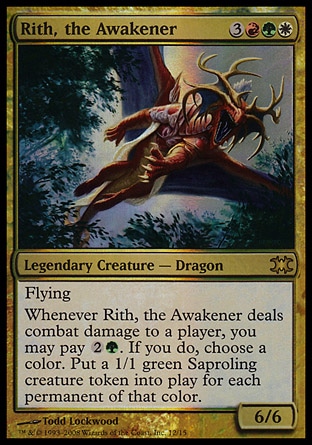
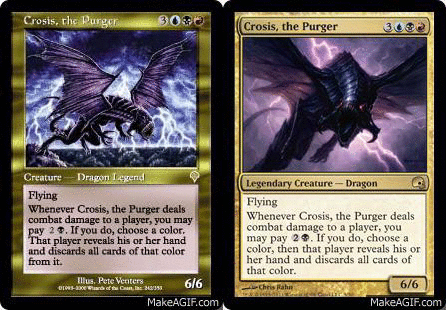
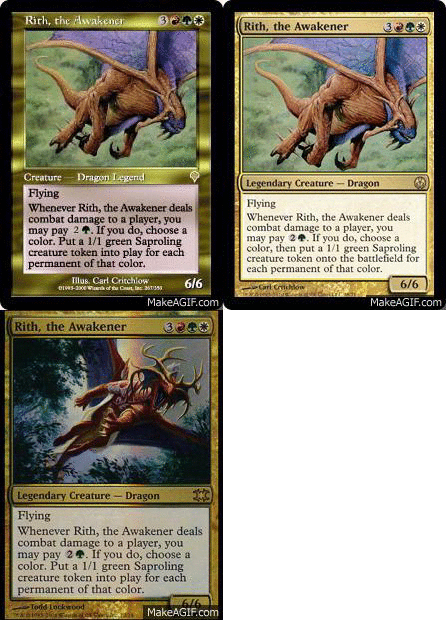
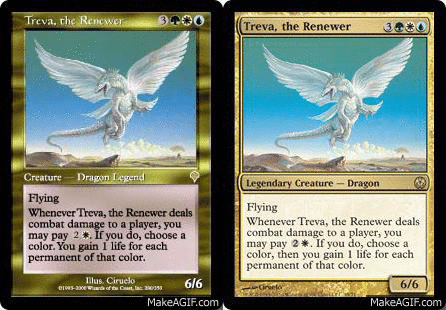
All of them except Dromar got new border updates in Wizards specialty products over the past few years.  Darigaaz, Rith, and Treva were part of Duel Decks: Phyrexia vs. the Coalition. Crosis saw new art in the Graveborn Premium Deck, and Rith got this sweet alternate upgrade in FTV:Dragons.

WotC likes to put nostalgia in circulation, and these cards certainly have that kinda quality. Commander was originally based on building around the Elder Dragons after all, and then by extension these guys, and their distant enemy-colored cousins in Time Spiral.

So if they do get printed, you're probably going to favor the shiny newness over the Old Guard, and that's pretty natural for us.

Still, I think there's quite a bit of fun left in these old dragons, and with much of the new tech, I think it's time we tried to get back to our Elder Dragon roots and brought these guys Back From The Brink.

Crosis, the Purger

Discard is strong, but playing
the guessing game and the strength
of his peers really render Crosis Obsolete.
Ranked Third in this cycle, but doesn't
outclass Dromar by much. 
Having Nicol Bolas as your Elder hasn't exactly been great for Crosis, who's just outclassed in Dragon-ness and nostalgia by the most Evil Lord of Evil in Magic. Bolas also has a far superior discard mechanic.

And I know, there are even other, better options in Garza Zol and Thrax if you're trying to get your Grixis on.

Still, Crosis isn't terrible. The 6/6 for six defense will get old in this little review, but he is a little bit better value if you want to have something that's slightly more castable and similar to Bolas.

If you're looking for metagame choices, Crosis is much better than Bolas against mono-colored decks. He comes out a turn or two quicker, which is usually the difference in someone preparing for Bolas and not preparing. His ability can also pressure an opponent to play their spells a little bit earlier than they'll want to, which could give you stuff to counter. Just remember to bring Haste.

Mostly though, I think Crosis is for the folks who like Flying Purple People Eaters and other assorted EDH Hipsters. He's definitely more theme or casual than function, even when he's not a Commander.

Rith, The Awakener

Rith is the best in this cycle.
Has access to two quality strategies:
Tokens, and Commander damage. 
Rith is a deck I saw quite a bit when I first starting playing EDH. He doesn't have a lot of problems in Naya because the options are few and mostly bad. Just ask GG about Hazezon Tamar.

Tokens are an EDH archetype, and Rith's definitely one of the leading leaders in Saproling-making technology.

Moving forward, I see Devotion giving Rith some extra power. I know that sounds strange when you look at his CMC, but if you've ever played against a Rith deck, your opponent basically wants to cast green permanents to match the color of the tokens. If you get an early hit in without anything but Rith on the field, or you're already overrun by your opponent, you might have other choices.

Red and White are mostly support colors. Rhys and Trostani have really taken off as the primary token Commanders, but the big advantage to Rith is that there's a little bit more tempo and versatility that can be created with access to Pyroclasm effects and evasion. Rith is also much more sizeable, which means he can also present lethal Commander damage on the board, using the tokens to chump, whereas the tokens in these other decks really need to swing because their Commander isn't going to get there.

Dromar, the Banisher

Poor Dromar. Maybe someday we'll
have a reason to pull him out of the
clouds and play him. Still manages
a Fourth Place finish in the cycle.
For many, many reasons, Dromar is definitely the one I most pity in this cycle.

If this were the Hundred-Acre Woods, our Esper Dragon here would definitely be "Eeyore." His design doesn't let him get out of his own way, which means he's kind of a mess. To quote my favorite reporter on the street, Mr. Brian Fantana, "Against 60% of the color pie, he will bounce himself every time."

Even worse- he is also severely outclassed by Sharuum, Zur, Merieke, and even Ertai the Corrupted.

That said, I can find a few decent reasons to use him. I like the concept of building around Commanders as a "Safety Valve," or even as a sort of "Poker Face" to confuse your opponent.

Like Crosis, Dromar's a pretty good candidate if you like to go deep. With access to decent control colors, it's probably safe to say that not many creatures are going to find their way on the board. If they do, token decks won't stay very long. Mono-Green decks in general are pretty bad matchups against him. So if you have a Timmy/Ramp style metagame, maybe this is a better option than it looks.

Also, being able to bounce him to your hand for control matchups make him a lot more re-castable than the rest of the cycle. I'm not sure if that's good, but I like to keep costs low and have a good threat at all time. Combined with counters and discard, this could prove to be a grindy way to maintain card advantage into the late-late.

Treva, the Renewer

I'm convinced Treva is worth playing.
The clear Number Two in this cycle,
and makes a strong case against Rith
because of his versatility.
Treva's actually my favorite in this cycle for several reasons.

The most unimportant of these is that I get to call him Falcor, and use my rarely seen and seldomly enjoyed "Neverending Story" comedy routine. Like this one.

Atreyu and Falcor walk into a bar, and sit down. Bartender says, "Hey, the bar's getting ready to close up soon." Atreyu replies, "Don't worry, we won't be here long." They get up and walk out of the bar, walk back in, and sit down. Bartender says, "Hey, the bar's getting ready to close up soon." Atreyu says, "Don't worry, we won't be here long." They get up, walk out, and walk back in. This time, the bartender says, "Okay guys, what's the story? You can't do this all night. The bar's getting ready to close." Atreyu looks at Falcor, then says to the bartender, "Sorry, we have Obsessive Compulsive Disorder, but don't worry we won't be here long." Bartender says, "Sorry to hear. Is there anything that can be done? Like, is there a cure?" Atreyu sighs, looks down at the bar, and says, "No. Unfortunately, it never does." Then they get up, walk out of the bar, and walk back in again.

Ba-dum pshhh...

Anyway, Treva's best quality is his color-access. Though they sometimes don't mix too well, having access Ramp, Wraths, and Counters means you're going to weather the storm.

Third, I think he has the most relevant ability of the cycle. Some people will tell you gaining life is irrelevant, which is true against strong Voltron decks and Stompy decks that go unchecked. However, I tend to think it's probably the most threatening thing people can do and still stay under the radar in multiplayer matchups.

Treva's basically the "Rith" of the Life Gain decks. There are a couple of nice little sub-archetypes that would really align with Treva well, like Turbo-Fog or Combo Life-Gain (The decks with Felidar Sovereign and Test of Endurance). Basic control decks really stretch that extra 2-3 life a turn to max value, using him to pose a threat and keeping Treva from being messed with.

The thing people most forget is that Treva can pick other colors with his ability, which is where his coloring also tends to help control versions of this deck that don't like to have a lot on the field. Overall, I just have a lot of high praise for Treva. One of the most underrated Commanders.

Darigaaz, the Igniter

Terrible. Just terrible. Outclassed in
just about every category I can think of,
including artwork. This is the ugliest thing
I've ever seen. Fifth n this cycle, and
even lower in his own colors. Not worth it.
The days of using Darigaaz were over early after Kresh and Karrthus pushed him down the totem pole, and that doesn't look likely to change after Commander 2013 comes out. Prossh, Skyraider of Kher, which was spoiled at Comic Con, is likely to outclass him in the dragon department and simply provide a better alternative to those people who don't want to play Karrthus.

Deep down, I think we all know Darigaaz was never any good anyway. Playing the guessing game with his ability hardly feels worth it for extra damage, because if you have him out, and that damage is going to be a significant factor in the game, chances are you're already winning.

Overall, I find him to be the worst in this entire cycle. I'm sure there are some nice interactions with Furnace of Rath, Gratuitous Violence, Nature's Will, Sword of War and Peace, and Double Strike, but if your general needs to find Magical Christmas Land to eke out W's, the prognosis is not good.

That's all I got for today. As always, feel free to speculate with me about Commander 2013, opinions on my opinions, and good strategies to bring these guys BACK FROM THE BRINK.

Until then, I'll be working on my Neverending Story comic routine. I suggest you work on your own pop culture joke skills too.

-UL