Showing posts with label cube design. Show all posts

Sunday, October 26, 2014

In General: Grandpa's Pauper Cube Part 4: Fast Facts

I am Grandpa Growth. You're a Zoner. This is The General Zone. On Sunday's here on the blog we talk about whatever it is I want to talk about...which for the last month has been Pauper CUBE!

Today we will finish my month long saga about Pauper Cube. We have discussed history, design, recent updates, and for my final act I will leave you with some fun facts and stories from my experiences with my own Pauper Cube.
  • In my original design for the cube, it was split into three sections based on different eras of Magic: Early sets, the block era, and the modern era. The idea was to draft one pack composed of only cards from each era. This would give the feeling of a full block structure where the block was the entire history of the game. Ultimately, I scrapped the idea because it was annoying to separate all the cards back into the different groups after the draft, but I still like the idea and am looking for another way to implement it. 
  • There are sub-sets of cards that support specific archetypes like Storm, Infect, or Defenders, that wouldn't normally be playable in the cube because you wouldn't be guaranteed to see the cards that your deck needed. The sub-sets are 15-20 cards that are randomly inserted into the draft packs as a whole unit. That way you are sure that drafting a specific deck is possible, but it could be very dicey if multiple people try to go in on the archetype.
  • I have also toyed around with the idea of shrinking the cube down to either 360 or 240, or at least having a sub-set for play in which all the relevant cards for Pauper combo decks would appear. It would be sweet to be able to have a limited environment where the archetypes are clearly defined. Storm, Midnight Presence, Blue/Black Reanimator, Jund/Reanimate, Dredge, etc. Who wouldn't love combo mirrors?
  • I originally wanted to include stickers to cover the art on the cards. These stickers would feature pop culture references, funny/cute images, or eerily similar pieces of art from outside Magic. If this sounds like a silly idea, that would be because it is. But alas, this is the kind of thing that my friends and I get a kick out of. Example:

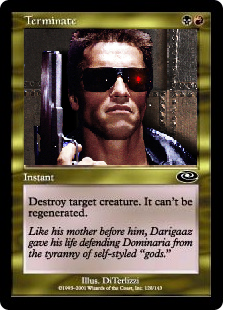
  • In my original design I also had several uncommon cards that I felt improved the environment and played particularly well. Strip Mine, Maze of Ith, Complicate, and a few others were all included.During my update for Born of the Gods, I decided it was time to remove them and have a truly commons-only cube. I think it improved the format, but the loss of such defining cards has definitely lowered the power level.
  • I had also created a sub set of uncommon cards that could be introduced into the packs just like I described earlier, but these were always uncommons from the latest set. A sort of 'Uncommon of the Month' club.
  • Can you guess which Magic set has the most cards in my Cube? ...it's Gatecrash. Here's the top five:
  1. Gatecrash - 26
  2. Return to Ravnica - 22
  3. Khans of Tarkir - 21
  4. Rise of the Eldrazi - 21
  5. Ravnica, Time Spiral - 18
Notice anything? There are a lot of lands in my cube, and therefore it is no surprise that the sets with land cycles are at the top of this list. Here is what that list would look like if you discounted the sets with major land cycles:
  1. Rise of the Eldrazi -21
  2. Time Spiral - 18
  3. Innistrad - 13
  4. Alara Reborn, Eventide, Planar Chaos, Tempest, Theros - 11
  • With the most current update, I have changed things around. My previous article stated that Portal Second Age was the only set from which I had not included a card. Well, that has changed. There are now two: Antiquities and M15. A situation that I will be looking to correct at my first opportunity. Past that, there are six sets at the bottom tied with only 1 card each. Those sets are: Urza's Destiny, Saviors of Kamigawa, Prophecy, and all three Portal Sets. 
  • I have chosen not to count Starter 1999 and 2000 as 'sets', but if I did count them, they would also be zeroes, technically. There are cards in the cube which have appeared in those sets, but I have not put any card into the cube that was ORIGINALLY printed in those sets. The reason being that they were mostly reprints so I treat them like pre-New World Order core sets (and all the cards pretty much sucked anyway).
  • The most common Creature type is Human. I would make a list, but there really isn't anything else that is even close.
  • I have played a two person Winston Draft where one of the players ended up with every single Extort Creature (there are 6). The odds of this happening are very slim, but not that unreasonable compared to what happened next. In one of our games he mulliganed to six cards and found that he had drawn all six Extort Creatures! The odds of this happening in his 40 card deck are 1 in 3,838,380. After staring in bewilderment for some time, he eventually decided that he needed to mulligan again.
  • The most life that I have seen gained off of a Crypt Incursion: 36
  • The most tokens that I have ever seen in play concurrently from a Lab Rats: 23 
  • The most tokens that I have ever seen in play concurrently from a Sprout Swarm: Strangely, only 7. This probably just means that you are more likely to outright WIN THE GAME soon if you go off with Sprout Swarm than if you go off with Lab Rats (citation needed).
  • Most damage dealt with a Sparksmith: 7, this record is unlikely to be broken because I have since removed many of the Goblin cards.
  • I have twice seen someone lose to a lethal Fireball for the full 20.
  • Most Mulldrifters cast in a single game: 5
  • The original build had a dedicated Tribal theme with spirits being featured prominently, but I never once successfully Soulshifted something. 
  • In my original 360 card design there were all six artifact lands and the UrzaTron, but no one ever got the full set of either into a single deck.
I can't recall anything else notable and this article has grown too long already. That is all she wrote on the Pauper Cube kiddies. I will be back next week with something COMPLETELY DIFFERENT involving one of my favorite new cards: Treasure Cruise
-GG

Saturday, October 18, 2014

In General: Grandpa's Pauper Cube Part 3: Cube Considerations

Hello Zoners! Welcome to In General. The Sunday segment here on The General Zone is about general topics applicable to Magic. Today's article is a continuation of a series all about my Pauper Cube.

In today's segment I will share with you the design document that governs how I build and maintain my cube. I think that this is the most important planning piece that you can do because it sets the stage for all the decisions you are going to make in the future. It is important to conceptualize what you want to accomplish and set out clear rules for how you will achieve those goals.

Guidelines

  • 540 cards, Commons only, designed for casual Booster Draft and Sealed deck play.
  • Singleton only, only one copy of each card is included.
  • The cube does not follow the Pauper banned list. There is currently no banned list for the Cube and all cards that have been printed at common at least once are theoretically eligible for inclusion.
  • No cards from Unhinged or Unglued are currently included in the cube although some cards from these sets have appeared in previous editions of the cube. E.g. Carnivorous Death-Parrot.
  • No foils. Although they look nice, many foil prints warp, bend, or curl. They are also heavier than standard cards. All of these factors make the foils detectable even through sleeves, which would give frequent players an unfair advantage over players that are new to the Cube play group because they could identify certain cards by the general shape that they take.
  • No foreign language cards. I only include the standard English printings of cards. Again, although they are desirable collector's items, they slow down drafting and gameplay if a player doesn't understand what a particular card says. This can also give more experienced players who could recognize card art or other features the ability to quickly evaluate cards in draft and create an unfair advantage. It is important to me that the cube stays accessible to new players. It is a casual format.
  • No textless cards. Same as above.
  • Whenever possible I use the original printing of a card from the first set it appeared in. Note: I will always allow players to use the Gatherer site to look up oracle wordings or judge rulings during play and draft. I assume all cards to work in the way that their oracle wording is stated in the event that it is functionally different than the card as it was printed.
  • Cube updates occur frequently, but always at least once when a new set is first released. I monitor how individual cards are used and how they perform. I allow myself to change cards on a one-for-one basis pretty much whenever I feel it is necessary, but I do like to give questionable cards a few weeks to prove themselves.
  • In previous editions, the cube expanded by two cards every time a set was released, meaning that it grew in size over time. With the release of Khans of Tarkir I committed to a major expansion of the cube moving from about 480 to 540 cards. This is already very large so I am not sure if I am going to continue my policy of adding two cards per set.
My Ongoing Goals for the Pauper Cube

  • Make every card legitimately main deck-able. Efficient sideboard cards are necessary for any limited environment, but value-added versions of common cards are much more likely to see consistent play in every draft.
  • Include at least one card from every expert-level expansion and modern core sets. 
  • Include cards with historical significance, notable tournament performances, or unique abilities. There is a limit to how far I am willing to take this though, Benthic Explorers, while unique for a Blue card, just isn't competitive in this limited format.
  • Include sufficient fixing so that drafters can take any card they want from a pack and realistically play all of their best cards in their deck regardless of color. Decks with better mana will get screwed less often than decks with less off-color requirements, so there is a benefit to being a disciplined drafter, but I don't want someone to feel left out if they are playing Blue/Green and the only removal they saw was Red.
  • As always, decks with a coherent strategy and solid mana curve are more likely to win, so I try to keep the average converted mana cost of all the cards as low as possible. I shoot for a target of 2.5 and try to keep the Creature count above 50%. This mix ensures that the average average deck drafted from my cube looks like an all-stars team of other limited environments. More colors, but tighter curves. 
  • Speed is one consideration that I often overlook. Proactive decks are good in this format, but pure Aggro decks often perform poorly. I want a way to create aggressive decks that win without giving up powerful taplands and multicolor cards.
  • The Cube, first an foremost, should be a fun way to showcase the awesomeness that is Pauper. If it isn't fun to play or it isn't a good ambassador for the format, then it isn't doing its job.
  • People should come away from a draft with a new perspective on how Pauper can be played. Most people underrate the power and depth of the format, assuming that commons are generally bad. That might be true of most commons, but Pauper is an eternal format and over the years some nasty stuff has gone to print. I want people to have that educational experience in an organic and entertaining way.
That is it for today. I will be back next week when I finish up my Pauper Cube series by sharing some fun facts. See you then, Zoners.
-GG

Sunday, October 5, 2014

In General: Grandpa's Pauper Cube Part 1: A Brief History

I have referenced my Pauper Cube in many of my previous articles, but I have never actually posted the list on the blog. That changes today. I will discuss Cube and it's history. I am going to talk about Cube, C/Ube, and Pauper Cube; the differences that interested me, where I got my start with Pauper Cube, and what my goals were/are for my own draft set. Let's begin.

Wherefore Cube?

When most people explain the concept of Cube to a new player, they do so by saying something like this: "It is a collection of cards that you draft from, just like regular limited, but it is made up of the best cards of all time!"

When the first Cube was built, that was probably true. Throughout the early years of community development, all cubes were very similar. There were only so many cards that were 'Cube worthy' and it was easier to make decisions about what to cut. There were only six categories of cards really: the five colors and colorless. For a long time Cubes were almost unanimously 360 cards, 60 of each color and 60 Artifacts/Lands. Hence the name: Cube, an object with six equal sides. Cubes rigidly followed the singleton rule. This configuration worked out perfectly so that an entire eight man draft pod could put together 45 cards in their pool and the entire set would get played.

As time went on and the game continued to grow Cubes grew along with it. There were now so many good cards that you couldn't always cram everything in and still have room to personalize. Cube designers started to experiment with the characteristics: size, composition, mana curve, themes, balance. Discrete archetypes grew out of this: Mono Red Aggro, Mono Black, Reanimator, Blue White control, 'The Enemy': mid-range value decks of varying color compositions, e.g. Junk. It was possible for cubers to design with these specific archetypes in mind so you could see consistency every time you played.

Divergence

Nowadays, Cube looks very different. Now the answer to the question of what Cube is has changed as well. A Cube is a player-designed, community grown card set for Limited Phantom play. That is a broad and nebulous definition, but at least it is wholly accurate. It is no longer appropriate to talk about Cube as "the best cards ever". That, simply put, is too narrow an interpretation and limits the potential of the environment you are trying to create.

I have seen a Plants vs. Zombies Cube. A Human vs. Zombies Cube. A Tribal Cube. An everything but Blue Cube. A Zoo Cube, which was awesome. Who do you think wins in the battle of cats, lizards, hounds, apes, birds, and fish? There is a Cube for every kind of player AT LEAST!

So when you decide to make a Cube, you are deciding on what restrictions you want to place on this new format. There really aren't any rules except that it should be internally consistent. It is like a comic book universe of Magic cards. You decide the characters and the setting and the story just plays itself out in every game.

An important step for me was deciding on what FORMAT I wanted my Cube to be played in. I love draft, so I primarily designed it with eight-man booster draft in mind. This is more or less the most common approach, but you can tailor any set to play differently in a given format, so keep that in mind. I knew I wanted to do somethings differently with my own Cube, but it took some digging to generate ideas.

(Magic the) Gathering Information

I began by reading. The Cube community has always been a strong, underground society. Back in the day there was no MTGO Cube for new people to look at so the only way to learn about Cube was to go and play somebody else's. I took much of my inspiration from Adam Styborsky's Pauper Cube, which is linked HERE! And also Eric Klug's Common/Uncommon Cube, seen HERE! I already had a friend with more a standard Cube so I knew from the outset that I wanted to do something different. Messing around the rarity restrictions seemed like a natural place for me to take it because I have such a deep love for the Pauper constructed format.

I wanted to create a draft environment that showcased the surprising power and incredible depth that Pauper has to offer. I wanted to show people that you can do very broken things, just like in regular cubes, but also show people some unique cards from Magic's past that would normally never get into a Cube.

With those overarching principles in place I starting building...but I have run out of time to talk about it this week. I won't leave you hanging, here is the list as it stands now: Grandpa's Pauper Cube. Next week I will go deeper into the design choices and my personal philosophy on Cube and after that I will talk about the updates I made for Khans of Tarkir. Till then Zoners.
-GG

Sunday, July 6, 2014

In General: Design by Request

Welcome to In General, the column where we discuss just about anything relating to the game of Magic. A couple of weeks ago I wrote about designing your own cards to fill specific holes in your Cube designs. The example I used in that article was a Black Disenchant. This was meant mostly as a challenge for players to think outside the box, consider design principles objectively, and take some initiative in crafting great experiences for your cube.

I want to make the point that I don't necessarily condone going off the rails and just making your own cards all willy-nilly. You might as well invent your own game at that rate. But at the same time, I think of all the great things that the community has contributed to the game: Invitational cards, You Make the Card promotions, the new outsider designs in M15. New formats like Cube, Winston draft, and Commander - some of my favorite things about Magic didn't come from Wizards at all. From that perspective, there is definitely room to create new experiences, especially in a format as unique and personal as Cube.

Since writing that previous article, The Disillusion Problem, I have been asked the same question many times in my personal life. My friends and readers all wanted to know some variation of the same thing: "What 'fake' cards do you think need to be a part of your Cube?"

That is a tough question to answer because in theory, all possibilities are correct, and those possibilities are infinite, it is just a question of finding the correct place to apply your design. Once you have looked thoroughly at your format and decided conclusively that something is missing, it should be obvious what effect you need to fill that hole.

What I just said requires one to think about a specific context. Which would inherently preclude me from thinking about any of these cards in a vacuum. All design is bad in a vacuum. Context provides the constraints that allow for the possibility of good design. Without that these are just some random cards that don't exist. Look at this meaningless collection of meaningless things!

I was always enamored with the card Fluctuator. Not because it was particularly good, but because it didn't do what I thought it should do. Mental Discipline was a Blue card in the same block and this always struck me as odd. Cycling is in every color. Why then, is the ability to cycle any card in your hand Blue? For mechanical reasons, I always thought this should be colorless. For flavor reasons, I thought it should be a machine, and thus an Artifact, instead of an Enchantment. The name I wanted to use however, was taken, so I had to simply reference it.


Duress has been printed a dozen or so times. There have been approximately a hundred variants of it. Why then, has there never been a spellshaper that produces the Duress effect? There are nearly a hundred spellshapers that create functional copies of all sorts of cards. I find it strange and dissatisfying that this isn't a real thing.

Also, Glengarry Glen Ross is a sweet movie.


I alluded to this design gap in my previous article. I see the formation of a super-cycle that gives each color access to its own version of this effect at the same converted mana cost, all at instant-speed. I don't see why not.


Brian David-Marshall once wrote an article that simultaneously lamented the fact that this card does not exist and predicted that it would never see print in the future. I can agree with his sentiments on both accounts. Many would find this card disturbing given the current direction that Wizards is taking Magic in. Remember though, in the early years of the game, there was no Negate, there was only Remove Soul. It was that way for many, many years. During those times it would have been equally sacrilegious to print Spell Pierce.


As you can see, many of these card ideas harken back to an earlier point in the game's history. It would be impossible to print this in modern Magic, but in the early days, things like this were quite common. It never sat right with me that only Blue and Red got elemental blasts. Particularly when Black and White are the colors where players would be most familiar with this archetypal hero/villain dichotomy.

It would be equally awkward to print 'WEB' and 'BEB', and then leave only Green out. It would be most awkward however, to give Green a card that counters spells and destroys permanents. Two things that, at the time, were completely outside of Green's color pie.


It is clear in modern design that this would be a Green card. Keep in mind though, that during the early years of the game Red blew up the lands, Red punished playing nonbasics, Red rewarded you for playing Creatures. It took years of design work to change peoples minds on this issue. When I first saw Silence in Mirrodin era standard, I was curious about what it would look like in other colors and, at that time, this iteration could very easily have been Red. Perhaps, a symmetrical effect like: This turn, players may not cast noncreature spells.'


There was a large theme in Magic for about the first five or so years that there were ways to change things about cards. Spells like Deathlace or Whim of Volrath were quite common. This is a new twist on an old idea. One that has fallen far out of favor in design because of its complexity and lack of intuitive conveyance. The current game though, would make this a very interesting card, given the new card types that have been created and the new interactions you can create with them.

Well there you go. I showed you some more fake cards. I think that is what you guys really wanted all along. There is no real way to establish that these are good or bad designs. Similarly I can't advocate including them in any design file because every format is different. Every designer has different goals. Every set has different needs. I cannot simply say, these should be in Cubes, because that statement is inherently flawed.

I hope you have been enjoying M15 spoilers. You can look forward to full coverage including set reviews and in-depth card analysis of all the Legendary Creatures in the set coming up in the next few weeks, so stay tuned to the blog.

-GG