For many years between Lorwyn and Innistrad I complained that the design of sets had become increasingly poor. Rares became more and more overpowered and polarizing, some were ridiculous and some were just ridiculously awful. Meanwhile, cards of lower rarities became essentially irrelevant. A variety of factors led into this, but the main consequences were that booster packs increased in price, but decreased in value; Limited environments became particularly stagnant, weighed down by uninteresting gimicks and impossible-to-defeat bombs; cards no one cared about got reprinted with abandon and the high-profile cards people wanted went under-printed (with the notable exceptions of Titans and some Planeswalkers). I was fed up. Suddenly, a change came! Innistrad drops and the world is upside down. We have commons in the tier one decks of every single format. Delver dominates Standard, Modern, Legacy, and even sometimes Limited for months on end. The draft format is fresh and engaging. It requires skill and there are clearly defined archetypes in addition to the typical two color nonsense decks. There are common/uncommon combos being discovered even late into the pro season. I was so excited. There were constructed quality cards at every rarity! Imagine that! Well the trend has continued through RtR block and now here we have Theros, which looks to be one of the juiciest sets ever. There is quality everywhere you look on this plane.
That was a lot of preamble, I know, but I am trying to cope with the wellspring of emotions that I am feeling. This is a rare thing for me, you see. Today, I am going to be breaking down my Top 10 new commons from Theros. Let us jump right in!
Honorable Mention: Boulderfall I get a huge kick out of this card. Brad Nelson, in The Magic Show's Theros Set Review called it "just Bogarden, because you don't get the Hellkite." I think that's funny enough to warrant a mention, but the card really is pretty sweet. This format looks to be a little on the slow side and removal spells will be at a premium. I am eagerly awaiting the first time I get to send one point of damage at my own guy to trigger a Heroic ability. In that context, this card is the Overrun of the Heroic decks; it pumps your whole team and you just send in the clowns, let them sort out the blockers. This card is pretty far away from being Rolling Thunder, but let's face it. Rolling Thunder is o.p. It was later fixed as a more expensive Rare...and then subsequently un-fixed a decade later as a potentially less expensive mythic, oh well.
#10 Voyage's End
A little bit of a strange pick here. This card doesn't read like the cards people typically get excited about. This isn't flashy. It's not a bomb. It probably isn't a high draft pick. But what it does, it does well. A strong tempo card that will fill out your deck and win some games. With so many Enchantments in the set this will rarely be pure card disadvantage. This reminds me of Vapor Snag, a burst of tempo with a small but tangible benefit attached. In aggressive decks Scry finds gas to help keep the pressure on. When you have to use this on defense it isn't as good, but the Scry effect will help you find a more permanent answer a lands to drop a big blocker.
#9 Two-Headed Cerberus
This little guy is pretty sweet. 2/3 Vanilla creatures for three mana have become pretty standard at common in recent sets. Which is a cool thing to see. Grey Ogres were never exciting and always felt strange when compared to Bears. They have a higher cost so it sends a bad message in design if they aren't superior in some way. The power/cost curve is central to the integrity of the game, although it often feels like it is defined by exceptions instead of the rules.
This creature is a cool upgrade to a standard 2/3. It's first point of damage has first strike and it packs on a huge upside if you can increase its power. Double Strike gets out of hand very quickly and if it gets above 4 you basically have The Abyss.
#8 Aqueous Form
It is hard to underestimate this card. It has a lot of raw power and as the game goes on it makes it almost impossible to lose. The immediate damage provided by having an unblockable threat is backed up by recurring card selection letting you out gas your opponent in long-sequence exchanges. These pseudo-race situations occur pretty often in Commander. This isn't some janky combat trick. This is an engine and the output is beatdownz.
#7 Cavalry Pegasus
Take to the sky! Giving your whole brute squad evasion is pretty sick and definitely worth much more than two mana. This is an efficient, low-cost beater than can quickly begin chipping away in your opponents life total early in the game and represent a crazy breakthrough attack later in the game. The fact that this can play the same role as an Overrun and just push through lethal in a board stall makes it an excellent draw later in the game as well. This only does one thing, but it does it very well. I expect to be seeing a lot of this card on my opponent's side of the Pauper table.
#6 Minotaur Skullcleaver
Inner-Flame Acolyte and Viashino Firstblade are super sweet aggressive threats. This is much easier to cast and therefore a pretty significant improvement. Four is a substantial amount of damage and later in the game people are not going to want to take a hit like that. This will create situations where you can set up a favorable trade or even a chump block. Haste is a proven quantity. It's awesome. It wins games. #5 Akroan Crusader
Tokens are super sweet. It only takes a few for them to really start paying dividends and if you really get a chance to go off you sometimes end up with so many that you can't ever lose. One drops are also super sweet. They don't really have to do much before paying dividends either. Sometimes early pressure can put you so far ahead that your opponent will have trouble coming back even if they stabilize. Sometimes you opponent is able to keep pace and outclass your one drops with bigger threats. The cool thing about crusader is that he can stay on the table and still be relevant even if he isn't attacking.
#4 Leafcrown Drayd
I see this as a DIY Thragtusk at common. Check it out, if you Bestow this onto a reasonably sized guy then you will be getting a pretty sizeable body on the board. If they deal with your monster, it leaves behind a smaller replacement guy in its place. Reach isn't exactly the same thing as five life, but oh well, what can you do? This is an awful lot of value for a card that can also fill the curve just like a regular two drop. Commons usually aren't this good people, this is something to get excited about! #3 Nimbus Naiad
I am unsure about these next two. I have gone back and forth about which is better. This card reminds me a lot of Drake Umbra, which some of you may recall was absolutely insane in limited. That card was an uncommon and when the creature got destroyed you just had to ditch the aura. Naiad gives you a similarly huge flier for the same cost, but when it gets removed you are left with a creature that still has Flying. Wind Drake now with added value.
#2 Breaching Hippocamp
Look guys. I am not going to try and defend the flavor. It is bad. I don't know why the horse if a fish. I don't know why it jumps out of the water. I get that the surprise attack from below the surface is modelling Flash, but I don't get how that maps onto untapping another guy. Luckily though, this card is crazy good. Having three power means that it will probably be able to trade straight accross with one of your opponents creatures, so in that sense it is basically like a clunky removal spell. The extra blocker is a huge kicker though. You will usually get to just eat one of your opponent's attackers for free. I can't wait to finally use my Ulamog's Crusher on defense, this is going to be so sick. Even if you can't force any awkward combat exchanges or generate any card advantage this is still a relevant, albeit unimpressive, body. It can attack and pick up swords just like everybody else. Any creature is good on an empty board. #1 Read the Bones
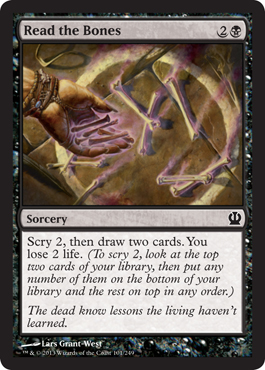
Read 'em and wheep! You might have been able to guess this was going to make an appearence on the list based on how I gushed for it in the set review. I can't help it. This card is the bees knees and everybody knows you shouldn't threaten your old Grandpa with a good draw spell. I will take advantage of that every time. I won't beat around the bush; I am unabashedly saying this: You will see this card in tournament decks. This is Top 8 deck list kind of stuff.
I am excited by the flavor text as well. It sets up so many jokes about learning your lesson and it is actually appropriate and relevant in actual teaching situations.
Hello Zoners, Grandpa here. Welcome to another In General, where we discuss top level strategy, game theory, developing your skills, what makes good cards good, the Commander metagame, and apparently now social psychology.
That's right, today is the first of many articles where I will be talking about Magic, Strategy, NOPE! Psychology. Joke is on you. Or your brain, rather. This is because we are going to examine a cognitive bias and how it can affect your play. A cognitive bias is a trick that your brain plays on you. It secretly urges you to make illogical decisions, view situations inaccurately, and collect/process information poorly.
Don't expect this is be a full blown master's course in social psych. I encourage you to continue your education. Knowing yourself and knowing others will make you better in all aspects of your life. This game isn't just cards and strategy; your mind takes center stage and you have to keep it sharp. If you let yourself fall into these traps then it will definitely cost you games. There are many of them, in fact here is a list: ShaB00M! Some of these may not apply to you, sometimes you might be in denial.
Confirmation Bias
What it is: The overvaluing of information which reinforces your view point. It causes you to dismiss or ignore information that disagrees with your established beliefs. This can manifest in several ways, some important ones are:
Selective Memory - Subconsciously, you retain certain information and memories while discarding others. In this case, we are talking about remembering evidence that supported your opinion, but not the counter-evidence. Ex: you remember that you won three die rolls in a row tonight, but don't remember that you actually lost more than you won. Resulting in the belief that you are the Roll Master. (A name by which my roommate actually calls me because he incorrectly believes I win more die rolls than him)
Biased Searching - You go looking for information with a preexisting agenda. You go looking for articles/advice that support you, so it isn't surprising that you find a lot of information that you agree with.
Observational Selection - You don't pay much attention, but suddenly now you start seeing something everywhere. Cell phone towers, for example. Normally, not a subject of much concern, but if you start looking for them you will find they are everywhere. This bias suggests that they are showing up more now than before, like they are multiplying. It is important to note that this simply isn't the case. The government has always been watching you, duh.
Mis-association - Sometimes, in pursuit of defending your entrenched beliefs you will wrongly perceive a connection between events or fail to observe a connection which does actually exist. This happens all the time in personal relationships: one party feels blameless and doesn't understand how their actions affect the other person. When confronted about it, this person will dismiss the other as being 'crazy' or 'overreacting' thus further vindicating their own viewpoint while alienating all others. Note that the related problem of association verse causation definitely falls into this category.
Illustrating Examples
Let's look at some samples of how confirmation bias can hurt your game:
There is a certain creature that you hate seeing. You are tired of losing to it. In your mind it seems like every time this thing comes out you lose. This creature, this Shmimeval Titan let's call it, is unstoppable, right? I mean, you always seem to lose to it, so it must be too good. What's really happening is that you are being handed piles of evidence saying that you need more answers in your deck, but all you can hear is: Shmimeval Titan is overpowered. When faced with controverting notions, you interpret it has reinforcing your point instead of detracting from it.
Let's say you play a lot of casual games. You are the master of the kitchen table. It feels like you win 70-80% of your games. Your deck is so good, right? So you go to post it online and these vultures on the forums rip it to shreds. You try to explain to them that you have a crazy high win rate, but they don't seem to get how awesome you are. Eventually, you just write them off. They aren't good enough to understand why you are successful. Maybe they are trolling super hard. Perhaps it is just the typically critical nature of anonymous commenting; they wouldn't be able to deny you in person. Here, you are receiving feedback that you had skewed results. Either, you haven't been keeping accurate accounting of your wins and losses or you are playing against statistically inferior competition. Because of your cognitive bias however, you will not see any of the underlying factors that happen to be very relevant to your view: Strength of competition, relative play skill, match up considerations, individual players' expectations for game play (i.e. the vagaries in the 'spirit of the format'), luck...these factors differ vastly across playgroups and severely affect the outcome of games. Knowing exactly what factors contribute to a win can be difficult, but be sure to keep an open mind. Third party feedback has the innate advantage of NOT being subject to your biases.
I hope you enjoyed this article. I hope even more so that you you were able to take something positive away from it. Self-improvement is core to the human experience. It drives us. Often though, we must look inward for the solutions to our problems. The mind is a powerful and necessary tool, but it is also the source of nearly all of our struggles. Educating ourselves about these pitfalls will help us correct them and even avoid them in the future.
If this wasn't exactly your cup of tea, fear not. I will be doing at least another one of these in the future, but for next week I am going to be talking about some Pauper shenanigans and new cards from Theros!
Apologies for the last couple of break days. Life seems to have us preoccupied a little at the moment, but we appreciate you guys checking in with us on our regular "skedge."
Cause we're here today, responding with, well, responses.
GG, VJ, and I picked out our faves to share with you today.
So let's get to it!
THIS IS THE STACK!
GRANDPA GROWTH'S PICK
Grandpa Growth- THUMBS UP
Have your friends ever gone to activate a fetch land at a somewhat inappropriate moment? Maybe they just wanted to save time or were bored because they didn't actually have anything to do on your turn. S that D. Shut that down with your instant speed Sinkhole...aaaaaand then draw a card for the maximum strength rub-ins. In order to prevent long term scarring, you should apply cold water directly to the site of the burn.
Venser's Journalist- THUMBS UP
I agree with my cohorts: tutors are played at a sickening frequency, and what better way to insult the tried and true Demonic Tutor than by drawing a card for two mana? Some of the best control I've seen, or it could just be that I like everything about Ravnica.
Uncle Landdrops- THUMBS UP
One of the funnier memories I have of this card is a turn where GG played it in response to try to draw into a counterspell and then tried to crack his fetch land EOT. Hence came the line we've repeated a lot since- "Sometimes I play this game."
Good pick. Tutors are annoying. Shut It Down.
VENSER'S JOURNALIST'S PICK
Venser's Journalist- THUMBS UP
I have a lot of fun with this card because I don't see a lot of other players using this. When I first saw it, lights went on in my head and I thought, "hmmm, could be a Blue kill spell, or Path to Exile." I've been using it ever since. It just seems like one of those unexpected game-changers, and I have indeed used it against a Volcanic Geyser for 30 damage.
Willbender was a close second as well, since I've seen Willbenders turn Doors to Nothingness on their owners.
Uncle Landdrops- THUMBS DOWN
I've had a lot of trouble with this one, and I was hoping it would be tech. I'm glad VJ's getting mileage out of it though. I will continue to try to work it into various lists, but so far I've had no luck.
Grandpa Growth-THUMBS UP
This is a pretty good one. I was glad to see it get moved down to CMC2. There have definitely been superior versions in the past, but I think this in a great place for basically every format except Legacy; where cards have to be unfair to be playable, of course. I couldn't see myself actually starting this in a Commander deck, but then again, I am amazed someone started a Volcanic Geyser. What do I know?
UNCLE LANDDROPS' PICK
Uncle Landdrops- THUMBS UP
This or smacking the Temple Bell is probably the most likely response I have to most plays, and of those two, Miko is obviously my favorite. What can I say? I love land.
This usually isn't a desperate move either. I do this in response to people playing dudes, ending turns, upkeep triggers, etc. I play a lot of answers usually, so this is more about meta-interactivity. It's what I do before I decide to do something. Or nothing.
Also- being proactive on the draw creates a different dimension to the game. Most of the time it's pretty likely I have an answer already in hand, and I like to think it helps keep my opponents feeling some kind of pressure.
Grandpa Growth- THUMBS UP
I have never not played this in an EDH deck. That should tell you something about how much I use it. I eat breakfast maybe once or twice a month. I activate Mikokoro like, every day. It is extremely powerful. IF you aren't using this in all your decks you just don't get it..or you don't want to win.
Venser's Journalist- THUMBS UP
Temple Bell is a tad more preferable simply because you don't have to pay 2 each time you activate. However, the advantage of this is you can start pulling sly UL style bluffing by turn 3, if all goes that way. It serves two purposes, but I guess the second one is a better response than adding 1 mana to your pool. Unless someone plays Armageddon. Then you might want to put something in your pool before all is lost. But even then, you might be able to draw a land with the second ability.
As always feel free to share your favorites in the comments below.
Please tell me you'll respond. Until then, have an A1 Day.
The past week or so has felt weird, but I think we're getting back to schedule.
So it's time for America's favorite ongoing segment about all the Jank Hipster Tech I'm trying out, so get out your Grandmother's old sewing wheel, or your Grandad's old record player- It's time to figure out if I'm playing stuff that's worth anything.
Maybe someday we'll be able to stop talking about Theros on this blog. However, that dawn is still coming.
Still, I think this one's going to impress. My preorder stuff showed up in the mail yesterday afternoon, so I figured I'd share some of my bad cards.
But first, we gotta clear the old clutter out of the way.
LAST TIME, ON SPIN...
White cards seemed to be the theme last time, and it made sense. My Lin Sivvi deck was getting off the ground, and I was also trying to get desperately inspired by a creatureless Tajic deck that was a little rough on the self-esteem.
In the right hands, this card is gigantic value. Truthfully, there were several opportunities I've had to completely shut down Voltron decks and other Commander centric decks, but I let my sympathy bones get the best of me, and decided to play it on something else or pitch it.
I really like this card though. I know because of Theros people will be packing more enchantment hate than ever, but it's still an obstacle. There are several decks that have very few ways to interact with it, most notably red, black, and blue, and this card has the potential to hose people if their deck is flimsy. It's a bad card that punishes bad players with the word of a bird. What's not to like?
I almost want to play a couple copies. Not every deck plays multiple answers to threats, and having additional design support through Peek effects or other discard can really make this card that much stronger. It's a lot better than I thought it was.
One of the craziest suggestions we had for a senior prank back in high school was to get an elephant and stick it in a classroom on the second floor with a bunch of mice running around. Apparently, elephants are terrified of them.
To this day I don't know how we thought that was realistic, but the image is a pretty good illustration of what Shinen can do. Swaying chump blocks in combat is usually relevant in green, and is a different kind of way of interacting if you're sick of being the "Overrun Guy."
Yavimaya Hollow also helps keep this thing alive.
CONTINUING QUESTIONS
This time around I don't have cards that are pure flops. I'm still unsure, but we're still going to get them out of the way anyway.
I've had this guy out in several games now, and I've come to the conclusion no one, understands this card, including me. It's clear that Gideon's power was seriously quelled in development, making him very niche-y, favoring token matchups to get his counters on.
After this, I've been fairly lost. To me, he's just not a threat. There's no way that you'd have incentive to exile the entire board state in Commander, even if you did get enough counters on it to go off and start swinging. So in regards to restarting, it's worse than Karn.
Still, he tends to draw attacks on the table. I got kinda heated in a particular game where my opponent's felt this was a threat in the early game, killing him in two turns, only to let my Elspeth Knight-Errant stay resolved for about 3 turns after that. It wasn't about drawing attackers either. It was about the fact that simply because he was a Planeswalker, it made people scared.
Overall, it's just been really odd, which has made for an interesting case study. I hope to find a conclusion here at some point though.
Tajic was an indestructible man, but I didn't like the deck. Unfortunately, that means the ol' Weatherlight, like me, is currently doing the job hunt. I really do like this card.
It's a nostalgia pick, but I might have room for it in when I finish putting together Daxos. We'll have to see.
THE NEW STUFF
Alright, we've reached the main event.
BEHOLD! GOOFY THEROS RARES!
Colossus of Akros
GG had an article a while back based on Sam Stoddard's Concepts of Threats.
This is surely not a premier threat like Emrakul, Kozilek, or Ulamog, but it's about as far as I venture Wizards will go when they print a potential Trample/Indestructible 20/20.
I'm trying this card out in Blue Braids, where all my overcosted Timmy cards go. At the very least, it's intriguing to see if I can get him swinging. If I can't, at least I have a big blocker.
Gift of Immortality
Obvious flavor fouls aside, I think GG was a little rough in the Set Review on this one.
This is a card I like quite a bit. Decks with proper sacrifice outlets and ETB/Dies triggers really like the value adding here. I have a new trigger happy deck that is going to abuse the tar out of Gift, and I'm excited about it.
Prognostic Sphinx
Braids is getting another nice addition to its small Sphinx subtheme.
It's not much of a threat, but having a castable threat that will contribute to getting card advantage goes a long way in longer games.
More importantly, I'm excited at the chance to re-invigorate a deck I really haven't been playing a lot of games with.
Unlike KFC's terrible marketing campaign
for their new wings, this little spell
seems pretty tasty. Don't eat it though.
Hashtag, I Read The Bones
Read the Bones
This one isn't nearly as sketchy of a pick. I picked this cause all the other black cards I'm going to play are pretty obvious- Erebos, his Whip, and Hero's Downfall.
Read the Bones is a really nice budget option for every deck, and is another great Pauper option. I got a playset of this card. I can't wait, and neither can Greel or Glissa T's.
Reaper of the Wilds
Speaking of Glissa T's- she got a billion playable goodies from Theros.
Aside from the relevant God Weapons, this is one of the better fits for GB decks in general. All of the good Golgari Legends like to kill things. Reaper of the Wilds not only makes those triggers worthwhile, but also the ability to chunk damage and force trades with big blocks.
Five toughness keeps it from dying to other midrange dudes in the same size, and bonus- when it does die it will trade with something probably bigger than it.
It's a nice one. Play it. Love it.
Well, that's all I got. Feel free to share your favorite new tech with me as we begin to play new Theros tech. I'd love to hear about it.
Until then, keep the world turning by doing some Spinning. Make everything a myth.
Tip o' the hat to you Zoners. Sorry about the late post. Grandpa Growth here, and today I want to talk about something a bit different. This is a blog about Commander. In General is an article series focusing on high-level strategy concepts, theory, and metagame considerations. Today though, we are going to talk about Momir Basic. I do this, so as to illustrate how you can learn different aspects of Magic strategy by playing different formats.
Commander is difficult. It has all the complexity of every other constructed format, except with an almost completely unrestricted card pool and only a loosely defined metagame. You sometimes have good ideas about what is going on. Sometimes, things are completely off the grid. It is important to isolate certain skills so that we can train them without having to worry about other difficult aspects of the game. The same way an athlete uses certain drills and exercises to improve specific aspects of their body, so too can we develop ourselves by isolating skills.
First, if you are unfamiliar with Momir Basic, it is a blast to play and I highly recommend it. You can read the full description of the format here: B00M! I am not going to discuss the actual strategy of Momir or my opinions on MtGO Avatar formats. I encourage you to mess around on Magic Online and play a few games. The rest of this discussion is going to require a working knowledge of the format.
Things you don't have to worry about in Momir:
Mulligans - The first decision of the game. Often the most difficult. Many constructed games are won and lost by poor mulligan decisions. In Momir, you have the option to mulligan, but there is never a strategic reason to do so....therefore you never have to and you never have to think about it.
Mana screw/flood - Your deck is entirely composed of basic lands. You choose which lands to play from your hand and you draw a new one every turn. This ensures you will always have enough mana to make a play and you will always be able to utilize all of your mana.
Choice of play - The voice of the internet has not achieved consensus about whether or not it is correct to play or draw. There are legitimate benefits to both, but whether the choice is relevant in any given game depends entirely on what creatures you get out of Momir. The easy trick here is that you will already have picked out your strategy ahead of time, so you will always know which option is best your for your play style.
'Sandbagging' - You don't have disruption or removal in your deck, as I mentioned. As a consequence of this you don't have to think about using said removal now or saving it for later. You don't need to think about the Blightsteel Colossus in your opponent's hand...he doesn't have it.
Hidden Information - You don't know what lands your opponent has in hand, but that isn't typically relevant. You opponent has only lands in hand and can't ever draw anything else. So basically everything you need to know is available. Sidenote: there is a generally accepted order to which lands should be played when. If available, you want to play Mountain > Swamp > Island > Forest > Plains. If you see lands played in a different order then you know either that your opponent doesn't have a certain type of land in hand or that they simply don't care (read: is not very skilled/educated about Momir).
'Land Mines' - You don't have to worry about losing out of nowhere. Your opponent isn't playing a combo deck. They aren't assembling some unbeatable engine. The possibility of them making a super-sick bomb is ever-present, but you can't control for that and there isn't much you can do about it except for trying to leave blockers for a Haste Creature. At some point, your opponent is going to start making a Creature on every turn, expect it.
Resource Advantage - Caveat: Your life total matters. A lot. Other resources are somewhat fixed. In the late game, you will usually have the same number of lands (8) and the same number of cards in hand (0). Unless one of you breaks the symmetry somehow, e.g. with a mana acceleator or card-drawer, then things are going to stay more or less tied. You each have the same potential to get these extra resources and their appearance is totally random, so you don't really have to plan for it, but you do have to react appropriately when they show up.
The Metagame - There is no such thing as a bad match-up. There are only a handful of strategies, so it is easy to familiarize yourself with the strengths and weaknesses of each. Most people just pick their favorite or the one they think is best and run it the same way each game. You have the same deck and the same capabilities as your opponent. There is no budget deck. There is no insanely overpriced card that ruins formats. It is purely read and react to what happens in the game and what your opponent's strategy is.
Construction - Technically, the composition of your deck does matter to some degree, but most everyone can just find the tight decklist online, or right here: 15 Mountains, 12 Swamps, 11 Islands, 11 Plains, 11 Forests. Pretty simple. You don't even need to understand why this is good. Just play it and don't worry. Netdecking at it's finest.
Zones - If it isn't in play, it really doesn't matter. The lands in the graveyard are pretty much gone. Only a handful of creatures will ever interact with them. The tokens you make get exiled and cease to exist when they leave the battlefield. So, they are gone forever. You can't 'cheat' stuff into play or fiddle through your deck that much.
Side Boarding - There ain't no side and there ain't no board, there is just the tokens you make.
Things you do have to worry about:
Math - You have to keep track of life totals, power/toughness, and where your opponent's curve is topping out. Momir will develop your combat math to pro levels. Knowing when you are ahead or behind is extremely important.
Reading - Read every single token that comes down. No exceptions. You have to know what everything on the board says at all times, this is mission critical info and tiny mistakes will cost you the game. This mental skill is one of the few advantages left in this format. You need to be able to keep track of what your opponent has in terms of creatures and lands and what you have as well. Protection, Landwalk, and Islandhome are surprising relevant.
Memory/Knowledge - Remembering what cards exist in the game of Magic is hard. There are thousands and thousands of creatures. But there are some key things you will want to know that can give you an edge. There are more Haste creatures at CMC 4 than at any other mana cost, for example. That could be handy knowledge if all you need is one extra attacker or one point of damage to win the game this turn. You should get an idea for the relative concentrations of cards with certain abilities at each CMC. You might be thinking that this knowledge isn't going to be useful in Commander, but there is a corollary: Start building up your knowledge base of cards relevant to Commander. Know what kinds of things a deck plays on a given turn. Both with respect to particular decks and the format in general. Even easy things are a good start. If your opponent has a ramp card they will be playing it as early as they can. Sixth and seventh turns are usually going to be spent casting threats. What counterspells can your opponent have given his open mana? These are smart questions to be asking that will help you win games through sheer awareness.
Sequencing - When to attack first. When to make a token first. What if you get a Haste guy? What if you get a Bloodthirst guy? This happens. It is important to think carefully about how you use your turns. Know when and why to use each option available to you and do so correctly.
Targeting - You will still have to make some choices about what to use and what to use it on. If you make a Nekrataal you still have to figure out which creature to target with the ability to maximize your chances of winning the game. It is important to think long-term and perceive the situation accurately. Don't make short-sighted decisions that will cost you later.
Tempo/Racing - Although most games are a race, they tend to last pretty long. Every turn you can pressure your opponent increases your chances of winning. Games essentially always end with damage, every point is important. Read the board state correctly and don't let points of damage slip by. Take every advantage you can get. If you just sit around waiting for a bomb card to come out there is a 50/50 chance it will be on your opponents side of the table. Minimize the variance through superior play skill.
Board Stalls - Because each player generally makes a Creature on every turn...and because the majority of Creatures at a given CMC are nearly equivalent in power level, the board tends to remain at parity until the symmetry is broken by one of two things: 1. Making a Creature whose power level is dramatically off-curve i.e. big hits or misses. E.g. Oracle of Mul Daya or Cognivore. 2. Someone decides to skip a drop in order to make a creature on a later turn. Typically, people don't make one drops, but if you make one and your opponent doesn't. You will have an extra creature for several turns...for whatever that turns out to be worth. The skill to develop here is to know when it is safe to attack to try and end the board stall and what price you are willing to pay to do so. Making sure you come out ahead on creature trades and don't take excessive amounts of damage to keep your guys on the table are key concerns.
I hope you enjoyed this article. This is a new thing that I am going to be trying over the next few weeks. Talking about the merits of other formats as learning tools instead of outlets for play or socializing. It is important to try and improve your game as much as you can. You will win more and have more fun as you gain a deeper understanding of the different mental levels of the game. You may not like playing other formats. I for one, really like playing Commander. I don't like Standard, but there is always something to be learned by broadening your horizons.
We're releasing our inner Art Snob today on The Stack as we talk this often-seen-but-seldomly-appreciated part of Magic.
I've found that as I continue to play this game, art has become one of the subtle differences that has influenced my deckbuilding as of late, whether it's just playing alternate artwork to help reinforce the theme, pure pimpage, or a little bit of both.
I have a lot of respect for the creative process. So much goes into making Magic cards, and I think getting the artwork done is the most difficult part. Art on a card is a lot different than on canvas. It takes real skill to develop a piece that really complements a card's frame and border. For those who haven't played Magic since the dawn of time, they've come a long way from say, the Chronicles/Arabian Nights printing of Fishliver Oil.
This just looks like a day on the lake.
In 1973.
So it's time to be thankful. THIS IS THE STACK!
UNCLE LANDDROPS' PICK
Uncle Landdrops- THUMBS UP
With art and other things that are viewed as an expressive medium (music, films, literature), I tend to hold one simple-but-difficult first impression piece of criteria:
If what you're reading, watching, looking at, or listening to ever grabs your attention so completely that it floods your senses and reminds you of those things that connect you to the world, chances are it's pretty good art.
Steve Argyle's work on Admonition Angel is one of the first Magic cards that had this effect on me. Back then I didn't worry much about the top half of any card, which is something that newer players probably don't care about anyway. Admonition Angel didn't really change my sentiments either, but it did make me stop and admire, which I'd say is the beginning of my appreciation for art on the card.
I've stared at this art many times since, and there's just so much to love about it. The perspective is sweet, the light and contrast are immaculate. Even the stained glass has beauty to it. Argyle is particularly fond of this color palette (Pink-Purple-Orange-Black), and you probably see a lot of his work without even knowing it. Everflowing Chalice, Deathrite Shaman, Chandra Ablaze, New Nevinyrral's Disk, Somberwald Sage- it's all Argyle. So not only is his art pretty cool, it's also printed on playable cards.
Johnny Confidant- THUMBS UP
I'm Always appreciative of Argyle's work, not to mention I have some of his aformentioned cards as key players in my Primary edh decks. New Bloodbraid elf, Praetors Grasp, and not to mention Damia are all cards he's done that are personal favorites of mine.
Mythic card, Mythic Art, Nuff said
Grandpa Growth- THUMBS UP
Up above UL talked about appreciating Carl Critchlow's work more in the Modern card era. An important transition began to happen around this time that redefined Magic from an artist's perspective. The creative department started mandating that art come to them in a digital medium. This had a number of effects, chiefly that old school artists like rk post and Terese Nielson and other big names had to shift how they created their works. Paint on canvas was no longer an acceptable medium. This created a huge style shift within the game and one that I think ended up being a net positive. Steve Argyle is part of what I consider the 'new wave' of MtG art. This logistic policy change allowed him to enter the game and showcase his incredible color, balance, and attention to detail. Now he is well known and well established within the game and is frequently called upon to work on high profile cards. He is in high demand at large events and conventions because fans of his work constantly want sketches, signatures, and alters of his cards.
Venser's Journalist- THUMBS UP
UL's quip about newer players not really caring about artwork much is absolutely true! Unless we're talking about my brief obsession with MTG when I was 8, before I realized it was an actual game with rules and strategy.
This card does have some impressive illustration though, which certainly fits the card's title. In a dark background, an angel shines light from her halo, and bears a sword (possibly, a sword of admonition?) to vanquish the evil that lurks in the darkness.
Then again, it is a cathedral, so what evil could lurk there except the one lady who falls asleep during all the sermons? Also, isn't the ground in Zendikar a bit to unstable to build a solid foundation for a church? These are just some technicalities that are running through my mind looking at this card.
VENSER'S JOURNALIST'S PICK
Venser's Journalist- THUMBS UP
Nothing is more refreshing than seeing a cool stream of water run through some misty looking trees. If I were thirsty and in a desert, this card would bring tears to my eyes. If I were in a dentist's office, this artwork would ease my mind, if only a little bit. Oh, beautiful streams of Blue mana, bear unto mine eyes this beauty in every Blue deck that I've built!
Johnny Confidant- THUMBS UP
Probably one of my favorite Land arts of all time, Recently in the M14 set Jonas De Ro has some impressive artwork pairing with Andreas Rocha with the Sunrise/sunset look of the lands. Artwork on lands are gateways to the world that we are in, core set aside it is truely the only way to see the environment of the plane while you play in it.
Uncle Landdrops- THUMBS DOWN
This particular art isn't doing it for me, but I do like John Avon's work a lot. The river rocks in this one are the big turn-off. GG will talk about Avon a little later, particularly concerning land, but I like a lot of his nonland pieces as well. I play a lot of cards with Avon art, and I don't tend to believe that's just a coincidence.
Grandpa Growth- THUMBS UP
Lorwyn had plenty of inspiring pieces of art. From a creative perspective, choosing to have islands depicted in rivers rather than in oceans is a stylistic breathe of fresh air. John Avon is a true master and an artist that the game simply couldn't live without. He brings in players. When people who are unfamiliar with the game see his art they know that the cards are a beautiful and professional product. Often, people are familiar with some of his pieces without being familiar with the artist himself. GRANDPA GROWTH'S PICK Grandpa Growth- THUMBS UP
Obligatory explanation of thumb criterion: In the game of Magic there are two artists that I think really impacted the game so significantly that it couldn't exist without them (at least not in its current form). These men are John Avon and Rob Alexander. They are best known for their landscapes, which are immaculate. They are two of the most popular, most utilized, and without a doubt most skilled artists in the history of the game. You get a thumbs up if your art is in the same league as the these two.
There is a greater challenge to illustrating creatures though. They have to seem lifelike. Not just beautiful, but also animate. They need to display anger, fear, kindness. These things don't always translate well onto the inhuman forms that populate the game's art. Critchlow is one of the best artists specifically for his work on creatures. He has been around the game forever and has illustrated some of its most iconic cards, particularly with respect to relevance in Commander. To name a few: Wildfire, Overrun, Memnarch, Darksteel Colossus, and Exhume. He also crafted the art for my favorite card: Sakura Tribe Elder. He is an excellent choice for reprints, as well. He has made fabulous updates such as the core set Phyrexian Arena and the Onslaught Clone shown above. In case this wasn't clear to some of our readers: this art is significant because it calls back to the original Clone art from Alpha; in a humorous way to boot.
Johnny Confidant- THUMBS UP
Originally I was going to say i've hardly used cards by this artist, but upon a quick Gatherer search i was proven Wrong. Sakura-tribe elder his previously mentioned friends are among my decklists not to mention edh infinite mana combo friend Exsangunate is also illustrated by him.
Not to sure, but i think my first rare from a pack was this Clone, Thanks for the nastalgia GG
Venser's Journalist- THUMBS UP
I am not an art aficionado nor do I have a particularly favorite MTG artist. But, I like the concept this art is seeming to portray. If you ran into a clone of yourself, and be honest, would your first instinct be to kill it? The philosophy of MTG knows no bounds.
Uncle Landdrops- THUMBS UP
With few exceptions, I'm not really fond of his work pre-Kamigawa. I find that before this point there are quite a few cards of his that lack definition and the contrasts that I prefer. Fortunately for us, his iconic cards were obviously given a lot more attention, which is economical and appropriate, and that's something I value. I like Quillspike, Murkfiend Liege, and Darksteel Colossus a lot, and his work on Legendary Creatures is pretty great- Rith, Memnarch, Infernal Kirin, and Heartless Hidetsugu are also nice, gritty looking cards which I find really define Critchlow's style.
JOHNNY CONFIDANT'S PICK
Johnny Confidant- THUMBS UP
Terese Nielsen has long been a favorite of mine, perhaps my most favorite artist. If there is a card I have that she has drawn I'll go grab it and use it. Her artwork is a soft and detailed expression that sometimes even blends together many different symbols and pictures into one work. Enter the Infinite, Decendant's Path, and Hunter's Insight are such examples.
Uncle Landdrops- THUMBS DOWN
Terese Nielsen art is fine. I'm not as much a fan of it.
Many people have theories about what art does and doesn't do. To me, all artistic mediums should work towards carving identity, which is what I find to be lacking. Her technique, as mentioned, is good.
Looking at Basandra, we can see exactly what I'm talking about. The best qualities of this piece aren't exactly "her" in this picture, but the way the we're drawn to the objects "around" her, which in this instance, also includes the wings attached to her. Though life-like and lovely, they are still a distraction as we attempt to look at a Legendary Creature, which is supposed to, in my opinion, have a little more identity. This probably would've been better for a non-Legend creature, which we can't necessarily totally blame Terese for in this case, but Wizards still didn't say "No."
Again, I find her to be a much better artist than someone who really can understand its appeal on the card. When we look at cards JC mentioned, like Enter the Infinite, or Hunter's Insight, I'm not wowed. These intangible things aren't particularly demonstrated well to me through her work for me to say I'm impressed.
Dryad Militant, Secluded Glen and Angel of Jubilation are pieces of hers that really work for me. None of the others really stick out for me.
Grandpa Growth - THUMBS UP
She is a true master and has been around the game forever. She is very active at conventions and has an impressive portfolio of non-Magic art as well. Her pieces, even older ones, have a unique look to them. The balance in her color use gives her art a very realistic feel. The soft earth tones and natural greens...there really isn't another artist in Magic who's colors look like this. This is what feathers look like. This is how they react under light. A stark contrast to the high-gloss, over-saturated look that many modern cards have.
Venser's Journalist- THUMBS DOWN
A little too gothic-cathedral-stained-glass-window for me; but, it fits the description of a Battle Seraph. Eat your hearts out, zealots, and gaze at this airbrushed beauty (whips don't seem so angelic to me...but oh well).
Well that wraps it up for this week. Be sure to share your favorite artist or art in the comments below.
Until next time, this UL and the TGZ gang telling you to take a day off, go look at a painting, and pretend you know what you're talking about. Enjoy your Saturday.
Precedent as well as other Magic-Speculators looking ahead at Commander 2013 believe this cycle to be included in each of the five expansions set to come out in early November.
Color me more skeptical on this particular set, but it isn't off base. Wizards likes to combine bang-me-over-the-head obvious inclusions with the scathingly surprising.
I guess that means I won't be surprised if they aren't, and I think that might be a good thing.
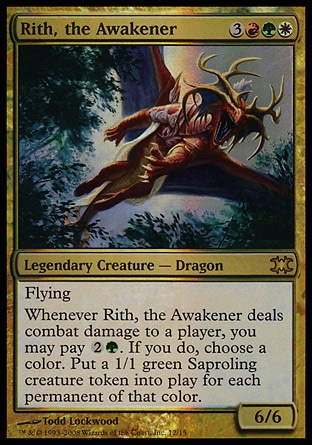
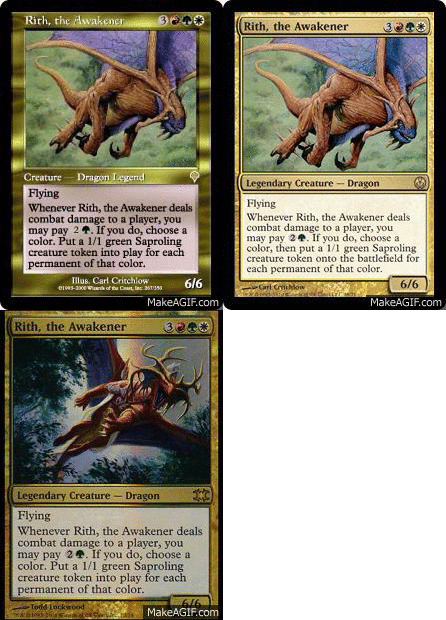
All of them except Dromar got new border updates in Wizards specialty products over the past few years. Darigaaz, Rith, and Treva were part of Duel Decks: Phyrexia vs. the Coalition. Crosis saw new art in the Graveborn Premium Deck, and Rith got this sweet alternate upgrade in FTV:Dragons.
WotC likes to put nostalgia in circulation, and these cards certainly have that kinda quality. Commander was originally based on building around the Elder Dragons after all, and then by extension these guys, and their distant enemy-colored cousins in Time Spiral.
So if they do get printed, you're probably going to favor the shiny newness over the Old Guard, and that's pretty natural for us.
Still, I think there's quite a bit of fun left in these old dragons, and with much of the new tech, I think it's time we tried to get back to our Elder Dragon roots and brought these guys Back From The Brink.
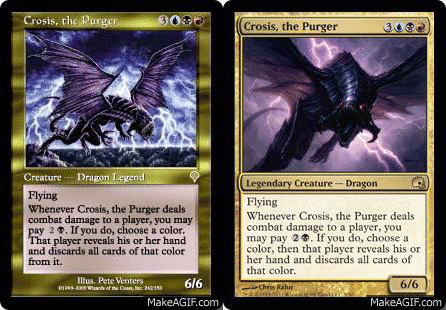
Crosis, the Purger
Discard is strong, but playing
the guessing game and the strength
of his peers really render Crosis Obsolete.
Ranked Third in this cycle, but doesn't
outclass Dromar by much.
Having Nicol Bolas as your Elder hasn't exactly been great for Crosis, who's just outclassed in Dragon-ness and nostalgia by the most Evil Lord of Evil in Magic. Bolas also has a far superior discard mechanic.
And I know, there are even other, better options in Garza Zol and Thrax if you're trying to get your Grixis on.
Still, Crosis isn't terrible. The 6/6 for six defense will get old in this little review, but he is a little bit better value if you want to have something that's slightly more castable and similar to Bolas.
If you're looking for metagame choices, Crosis is much better than Bolas against mono-colored decks. He comes out a turn or two quicker, which is usually the difference in someone preparing for Bolas and not preparing. His ability can also pressure an opponent to play their spells a little bit earlier than they'll want to, which could give you stuff to counter. Just remember to bring Haste.
Mostly though, I think Crosis is for the folks who like Flying Purple People Eaters and other assorted EDH Hipsters. He's definitely more theme or casual than function, even when he's not a Commander.
Rith, The Awakener
Rith is the best in this cycle.
Has access to two quality strategies:
Tokens, and Commander damage.
Rith is a deck I saw quite a bit when I first starting playing EDH. He doesn't have a lot of problems in Naya because the options are few and mostly bad. Just ask GG about Hazezon Tamar.
Tokens are an EDH archetype, and Rith's definitely one of the leading leaders in Saproling-making technology.
Moving forward, I see Devotion giving Rith some extra power. I know that sounds strange when you look at his CMC, but if you've ever played against a Rith deck, your opponent basically wants to cast green permanents to match the color of the tokens. If you get an early hit in without anything but Rith on the field, or you're already overrun by your opponent, you might have other choices.
Red and White are mostly support colors. Rhys and Trostani have really taken off as the primary token Commanders, but the big advantage to Rith is that there's a little bit more tempo and versatility that can be created with access to Pyroclasm effects and evasion. Rith is also much more sizeable, which means he can also present lethal Commander damage on the board, using the tokens to chump, whereas the tokens in these other decks really need to swing because their Commander isn't going to get there.
Dromar, the Banisher
Poor Dromar. Maybe someday we'll
have a reason to pull him out of the
clouds and play him. Still manages
a Fourth Place finish in the cycle.
For many, many reasons, Dromar is definitely the one I most pity in this cycle.
If this were the Hundred-Acre Woods, our Esper Dragon here would definitely be "Eeyore." His design doesn't let him get out of his own way, which means he's kind of a mess. To quote my favorite reporter on the street, Mr. Brian Fantana, "Against 60% of the color pie, he will bounce himself every time."
Even worse- he is also severely outclassed by Sharuum, Zur, Merieke, and even Ertai the Corrupted.
That said, I can find a few decent reasons to use him. I like the concept of building around Commanders as a "Safety Valve," or even as a sort of "Poker Face" to confuse your opponent.
Like Crosis, Dromar's a pretty good candidate if you like to go deep. With access to decent control colors, it's probably safe to say that not many creatures are going to find their way on the board. If they do, token decks won't stay very long. Mono-Green decks in general are pretty bad matchups against him. So if you have a Timmy/Ramp style metagame, maybe this is a better option than it looks.
Also, being able to bounce him to your hand for control matchups make him a lot more re-castable than the rest of the cycle. I'm not sure if that's good, but I like to keep costs low and have a good threat at all time. Combined with counters and discard, this could prove to be a grindy way to maintain card advantage into the late-late.
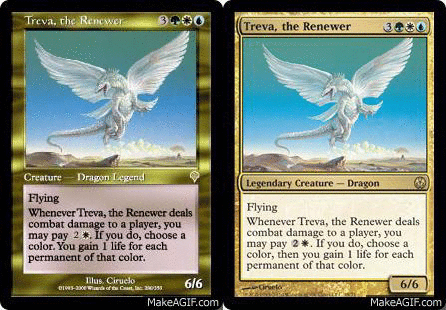
Treva, the Renewer
I'm convinced Treva is worth playing.
The clear Number Two in this cycle,
and makes a strong case against Rith
because of his versatility.
Treva's actually my favorite in this cycle for several reasons.
The most unimportant of these is that I get to call him Falcor, and use my rarely seen and seldomly enjoyed "Neverending Story" comedy routine. Like this one.
Atreyu and Falcor walk into a bar, and sit down. Bartender says, "Hey, the bar's getting ready to close up soon." Atreyu replies, "Don't worry, we won't be here long." They get up and walk out of the bar, walk back in, and sit down. Bartender says, "Hey, the bar's getting ready to close up soon." Atreyu says, "Don't worry, we won't be here long." They get up, walk out, and walk back in. This time, the bartender says, "Okay guys, what's the story? You can't do this all night. The bar's getting ready to close." Atreyu looks at Falcor, then says to the bartender, "Sorry, we have Obsessive Compulsive Disorder, but don't worry we won't be here long." Bartender says, "Sorry to hear. Is there anything that can be done? Like, is there a cure?" Atreyu sighs, looks down at the bar, and says, "No. Unfortunately, it never does." Then they get up, walk out of the bar, and walk back in again.
Ba-dum pshhh...
Anyway, Treva's best quality is his color-access. Though they sometimes don't mix too well, having access Ramp, Wraths, and Counters means you're going to weather the storm.
Third, I think he has the most relevant ability of the cycle. Some people will tell you gaining life is irrelevant, which is true against strong Voltron decks and Stompy decks that go unchecked. However, I tend to think it's probably the most threatening thing people can do and still stay under the radar in multiplayer matchups.
Treva's basically the "Rith" of the Life Gain decks. There are a couple of nice little sub-archetypes that would really align with Treva well, like Turbo-Fog or Combo Life-Gain (The decks with Felidar Sovereign and Test of Endurance). Basic control decks really stretch that extra 2-3 life a turn to max value, using him to pose a threat and keeping Treva from being messed with.
The thing people most forget is that Treva can pick other colors with his ability, which is where his coloring also tends to help control versions of this deck that don't like to have a lot on the field. Overall, I just have a lot of high praise for Treva. One of the most underrated Commanders.
Darigaaz, the Igniter
Terrible. Just terrible. Outclassed in
just about every category I can think of,
including artwork. This is the ugliest thing
I've ever seen. Fifth n this cycle, and
even lower in his own colors. Not worth it.
The days of using Darigaaz were over early after Kresh and Karrthus pushed him down the totem pole, and that doesn't look likely to change after Commander 2013 comes out. Prossh, Skyraider of Kher, which was spoiled at Comic Con, is likely to outclass him in the dragon department and simply provide a better alternative to those people who don't want to play Karrthus.
Deep down, I think we all know Darigaaz was never any good anyway. Playing the guessing game with his ability hardly feels worth it for extra damage, because if you have him out, and that damage is going to be a significant factor in the game, chances are you're already winning.
Overall, I find him to be the worst in this entire cycle. I'm sure there are some nice interactions with Furnace of Rath, Gratuitous Violence, Nature's Will, Sword of War and Peace, and Double Strike, but if your general needs to find Magical Christmas Land to eke out W's, the prognosis is not good.
That's all I got for today. As always, feel free to speculate with me about Commander 2013, opinions on my opinions, and good strategies to bring these guys BACK FROM THE BRINK.
Until then, I'll be working on my Neverending Story comic routine. I suggest you work on your own pop culture joke skills too.
Hey there Zoners! It's me Grandpa Growth. We're back for the final installment of the Theros set review. Today we are going to be balling out, talking about the remainder of the cards. That means the generic utility cards and stuff that gets your mana base looking all sexy.
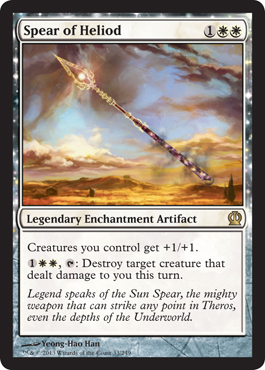
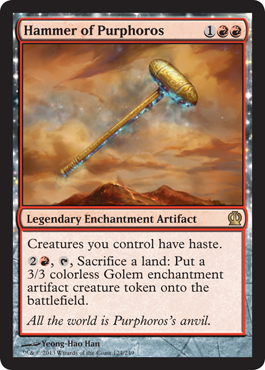
First up we have something sharp and apparently also pointy. Glorious Anthem sees some play in token decks. Particularly builds like Ghave or Rhys, but also more fringe decks like Darien. Since this is just a strict upgrade in a singleton format I expect this to be replacing pretty much every copy of Anthem in every single deck. There are certainly better pump effects, but this has the added benefit of giving you a free Reciprocate every turn which is pretty sick. I like these legendary weapon cards; they play so well in longer, attrition-based games and they can provide so much incremental value. You can expect to be seeing quite a bit of them in the near future.
This one feels a little bit weird to me because the abilities don't really work all that well in tandem. If you have a big token army on offense you probably don't have a problem just throwing a soldier in front of their guys or whatever, but I like how this added versatility plays. It keeps this permanent relevant even in situations where the Anthem effect is no good.
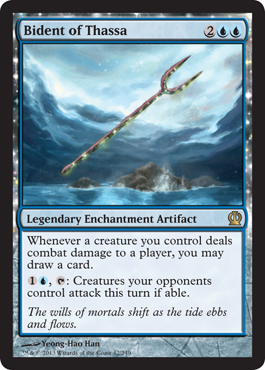
This is a huge update to Coastal Piracy, although I am not sure that is relevant because it never saw much play. The first effect is insanely powerful. The 1 Drop Edric deck completely flipped the competitive format and made us all re-imagine what a decklist, and a single Magic card for that matter, can mean in a game of EDH. Flying Men really isn't a thing in Commander, but if you draw a card every time it hits, and it gets to hit early and often, then we are talking about a sick little one drop.
This is what synergy is all about. And this card has synergy. It is insane in the Aggro-Control decks that want it, but completely worthless outside of that archetype. The second ability lets you theoretically control the board and get your guys to connect and draw cards, but...let's be honest. If you are playing a good Edric deck, all your guys have evasion anyway and your opponent isn't ever going to resolve a spell so they certainly aren't going to be able to block ever. Also, why forks? Fish don't need forks. Silly creative team.
If you are part of the 'in crowd' then you will know that drawing cards is the hip thing that kids are doing these days. If you are even further 'in' you are probably playing Night's Whisper and Sign in Blood in your Black decks. Cheap card advantage wins games.
Early advantages can snowball as the game continues and they often prevent you from getting pinned down by disruption or a board stall. Being a whole turn slower than the two previously mentioned cards is a significant cost, but if you top deck this later in the game it is much more powerful. If you have ever cast Divination and been disappointed you'll know what I am talking about.
The same problem NEVER occurs when you cast Foresee. Even if the cards you end up with are just as bad, you had CHOICE, which is crucial. You DIDN'T have you draw two bricks followed by another two bricks, you get to skip the feel-bads. Scry allows you to orchestrate better sequencing to maximize the time-value of your plays. It allows you to see more cards and thus gain more information about your future draws and the composition of your deck. Even just from a purely psychological standpoint, this will result in you feeling better about your draws whether they are truly better or not. Sidenote: I find cognitive biases a fascinating area of study and one that has direct applications to the mastery of strategy games.
I have no shame about low hanging fruit. You can waste time feeling guilty or you can grab that mess OMNOMNOMNOM.
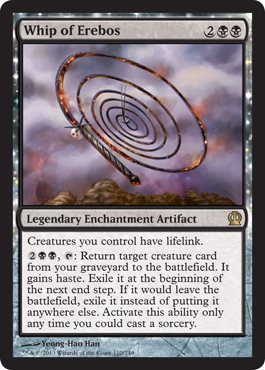
Soooo yea. Lifelink, eh? Honestly, the first line of text could read: "This is a meat popsicle" and I would still play this card. The activated ability is just that powerful. Rebuying creatures is an incredible way to punch through damage late in the game, generate card advantage when your opponent has to block, and in conjunction with the Lifelink it will keep you alive.
Black decks typically have no problems leveraging their life as a resource. Gaining big chunks of life is pretty cheap and its easy to turn that life into extra cards or Buyback on Slaughter, etc. I am very excited to play this because of its high power level and high level of synergy with cards like Necropotence, Dream Halls, and Geth.
Many mono Red builds include Fervor: Heartless Hidetsugu, Goblin Combo, Godo. So, in terms of power level and instant inclusion in existing decks, this card is a win. 3/3's are also pretty big for tokens, but sacrificing a Land is a high price to pay.
Even silly Red aggressive decks have ways to take advantage of extra mana and expensive late game spells that they want to be casting. I see this being most useful on an empty board where you control some equipment, just after a board sweep, for example. Making a token and suiting it up with a Sword is excellent value and very likely to get you back your 1 card down payment.
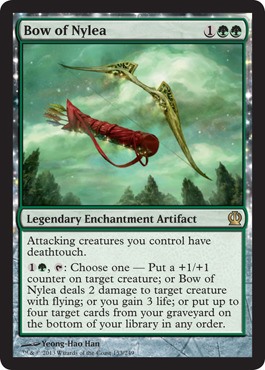
Finally, we have arrived! This isn't my favorite card, we will get to that later on, but it is assuredly the card that I will be playing the most from Theros. This is oozing value from every pore and I love it. I have never met an incremental advantage that I didn't like. I can't think of a Green deck that doesn't want this and there are a LOT of Green decks in Commander. Between The Stack, my spoiler articles and this Set Review I have given this card ample treatment so I will leave it at that for now.
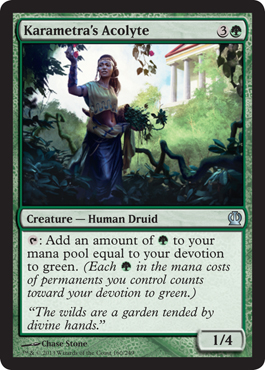
This card is expensive, especially for a mana producer, but it has high upside. There are boards where it could conceivably produce upwards of ten mana in a mono Green deck and any card that produces multiple mana is subject to abuse in combo decks. Now, I don't actually think that this potential will be realized; this card is just a little bit too weak to see mainstream play in quality decklists
This is more like it. Fixes all five colors and blocks early threats. That is a lot of work from a mana dork. It reminds me especially of Sakura Tribe Elder in that it prevents some early damage and can solve all but the most intense mana problems.
While this is an upgrade on Birds of Paradise because it resists Mental Misstep and Lightning Bolt, but it still isn't good enough for Grandpa Growth because it dies to Wrath of God, which Tribe Elder and Rampant Growth can both safely ignore. I still expect this card to see a lot of play in multiple formats so the initial price tag could be a bit of a barrier.
This will see play for the full length of its Standard legality, but if it can't make the jump to Modern the price boom should eventually come down, leaving more available copies for casual formats, where this card will enjoy a long and prosperous future.
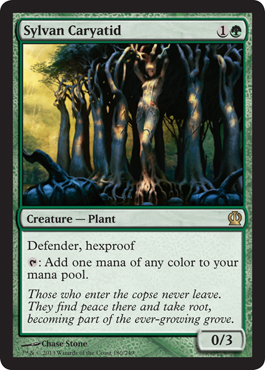
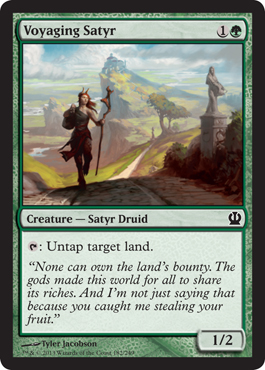
This is kind of a dorky card and there are already plenty of cards with similar effects. This card may not see much play, but the ability to tap a Gaea's Cradle or Cabal Coffers multiple times in a turn is powerful enough that it is worth mentioning. I am unsure what effect this being a 1/2 instead of a 2/1 has on its playability, but I typically think of lower power as being worse for a creature regardless of its toughness.
On a separate note, this is a Satyr, which is one of my favorite mythical creatures so that is a plus in my book.
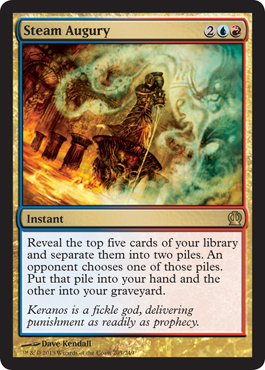
If Bow of Nylea isn't my favorite card then this certainly is. I love me some Fact or Fiction. I love it so much that I play it in literally every deck I own that can manage to put an Island in play. It is basically never bad. Five cards is so deep into your deck that you will almost always find something useful. I have Jhoira, Niv-Mizzet, Nicol Bolas, and Maelstrom Wanderer decks that can't wait to get a hold of this.
Unfortunately , this isn't fact, fiction, or Fact or Fiction, so let's go through some of the changes and what they mean. First, this card is more colors. It is harder to cast and forces you to play Red (you wanted to be playing Blue anyway, trust me). This restricts the card to only being played in these multicolor brews. As it happens this is one of the most powerful two-color combinations in Commander though, accounting for some of the top decks in the format.
Second, let's talk about the changes to the wording. Everything sucks. FoF allowed you to choose the better of the two stacks, yielding superior results essentially every time (assuming you make optimal decisions, which isn't a trivial assumption, mind you). Keep that parenthetical statement in mind, we will be returning to that idea.
Your opponent is most likely going to award you the worse of the two piles, barring some sort of multiplayer political chicanery. This makes it so that Steam Augury CAN brick where FoF never would. If you only flip one relevant card, no matter how devious your split is your opponent will be able to keep you from having it. In the situation where you flip over a good mix of relevant cards then it may make the choice difficult, that doesn't change the fact that your opponent now has the easier skill test.
With FoF they have to choose the split without knowledge of your hand. By forcing you to move first and making the split yourself you are giving your opponent information about what you value and what you may need. From a sheer numbers perspective, with FoF you only ever have two options, which makes choosing between them an easier task. With Augury you must make a choice that has a minimum of ten possible outcomes and the actual permutations of a five card set, where every card is unique and every split is legitimate, number well over a hundred. That is a lot of room to make mistakes ...which you will now be making instead of your opponent (as I hinted at above).
Overall, this card is substantially worse than its predecessor. Is it still good? Most likely yes. Remember that even bad versions of good cards are good because of the need for redundancy. Gifts Ungiven is very similar, but simply more powerful in this regard. The results are likely the same: you get the worst two cards from the available set, but I can think of a few stacks of cards where that is still quite good. I know I kind of went bananas about this card, but this is an area of game theory that is of keen interest to me and a topic that I will be visiting upon in greater depth in a future In General.
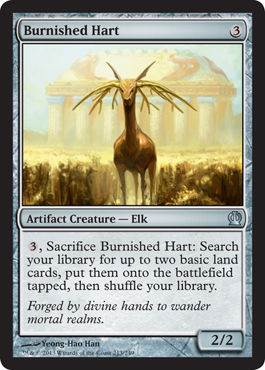
Colorless mana fixers are excellent, particularly when they provide card advantage. I make consistent use of both Armillary Sphere and Gem of Becoming. The fact that this can block, attack, carry equipment, and actually accelerates you on mana means that this card is poised to make something of a splash in both multicolor value decks and dedicated artifact theme decks.
I haven't talked about how much I hate the creative team for about thirty minutes while I have been writing this so I figure I am about due for a diatribe. Why is this an elk? Who makes these kinds of decisions? Why is it an anything? I am of a mind to think that all Artifact Creatures should be Constructs. Since it was built by something else (confirmed by flavor text), it is a Construct...or a Golem, which is just a magical construct. If it wasn't built by some other type of creature then it really shouldn't be an Artifact seeing as it isn't artificial.
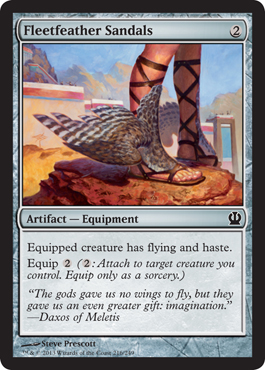
It seems like every block nowadays has a cheap knock off of Lightning Greaves. Some colors don't have as much support for Flying as others so I can see it being necessary to have some effects like this every once in a while, but those colors: Green, Red, and Black, have Haste creatures. Not to mention other types of evasion. Ergo, this card is either redundant (in the bad way this time) or unnecessary.
A good threat will have one of these abilities or some kind of protection from removal already. Greaves is so sick because Flying is way easier to come by than Haste or Shroud so it tends to work out in the general case AND Shroud and Haste don't typically occur in the same color so there is very little overlap. In fact, only Green and White have ever really scored this Haste, Evasion, protection trifecta and even then it only happens at the highest rarity.
Well. This isn't the kind of thing I typically go in for. It places you at a raw disadvantage on cards. An investment which you can only recoup by blind-flipping more relevant permanent cards than your opponent. This requires a big commitment in deck building to have both: more relevant hits than the sum of your opponents and better ways to manipulate the top card of your library. The problems with this are manifold:
-You don't want to fill up your deck with instants so you will be short on counters and removal, which is hardly ideal.
-You will inevitably have a number of 'soft hits' things like extraneous lands and ramp, Sensei's Divining Tops and associated Trinket Mages, etc.
There is almost no way that this can contribute to a victory in multiplayer. It will create interesting game states and the sort of over the top plays that Commander is famed for. However, not every one appreciates it. The randomness of this card and the general trend that it will help out your opponents some, even if it helps you more, lends itself to a political style of game play that can be both appreciated and hated.
I personally do not play and do not recommend that other people play group hug or group slug decks. If you want to play a deck with dedicated themes, that is fine, but if you are only building your deck with the intent to skew multiplayer games you are neglecting the most basic strategic concern within any game: you are supposed to try and win.
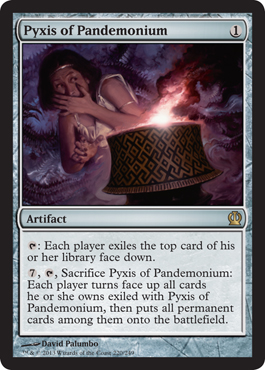
Compared to previously printed cards that fall into a similar vein (Knowledge Pool, Eye of the Storm, Cast Through Time, etc.) this has a unique advantage: It's is cheap to get into play. If you are playing something like this you are obviously trying to abuse it, so savvy opponents will know to try and disrupt your plan, but at one mana this is virtually never going to get countered on turn one. I just can't see myself using a Force or a Spell Pierce to fight this. To be honest, I can't imagine fighting over this on any turn, it just isn't good enough to be worried about.
Phew, I have gone on some long-winded asides today. Let's see if we can tighten up for the home stretch here.
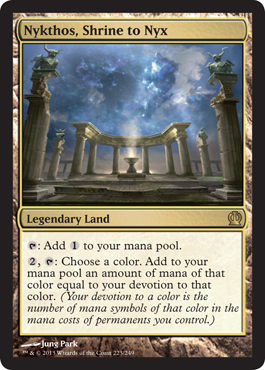
Nykthos is a powerful card. Anything that produces multiple mana can potentially be abused to great effect in Commander. Devotion is a new thing. It is going to take a while to really get your head around keeping track of Devotion in multiple colors for multiple players. I can virtually garuantee that the God cards will be popular, so in the near future Commander players will be building their decks with this concept in mind.
After that learning curve has taken its course we will be seeing a lot of this card and it will be doing a lot of work. Start picking up copies now, you will need them for the days to come.
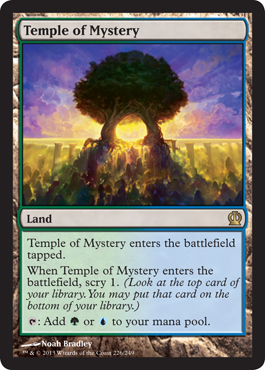
I really like this new set of dual lands. Always coming into play tapped is kind of a bummer and really hurts decks that really on tempo at critical spots on the curve.
Scry is powerful though and it will let you keep a larger variety of hands knowing that you will be able to influence your draws, even if it is only by a single card. New Benalia is deceptively strong and it is whole leagues behind this cycle. It doesn't produce multiple colors and the color it does produce isn't Blue, Black, or Green.
Even if this theoretical cycle of 10 isn't completed these five lands will still see significant play. They are excellent tap lands for people who are into that sort of thing and the control they give you over your draws is useful both early and late.
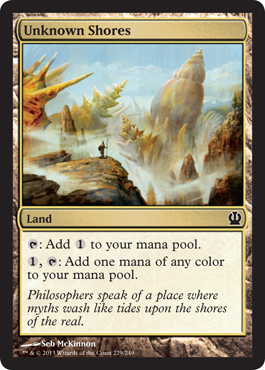
Last and most certainly least we have a Shimmering Grotto knock off. The original iterations of this card didn't even make it into my Pauper decks so it's unknown whether or not I will ever actually start this in Commander.
Well that is it. Theros in three easy payments. I am very excited for this set and am looking forward to many great stories for the prerelease, which at the time of this being written, has not yet occurred. Get out there and slay some monsters my friends and remember to leave your feedback in the comments below!